Student car maintenance checklist Carmichael students can use

A student car maintenance checklist doesn’t need to be complicated to be useful. For students in Carmichael, it should cover engine oil and other fluids, tire pressure and tread, battery condition, air filters, and key documents such as registration and proof of insurance. These checks can help you spot items that need attention before a commute or road trip.
It’s easy to focus on fuel and overlook the small maintenance tasks that help keep a car ready for daily driving. A simple routine makes these checks easier to remember, even if you’re new to car care.
Use this checklist to see what to inspect, which warning signs to watch for, and when a maintenance visit may help. The practical steps cover fluids, tires, the battery, air filters, and paperwork, and can fit into your regular routine.
Key Takeaways
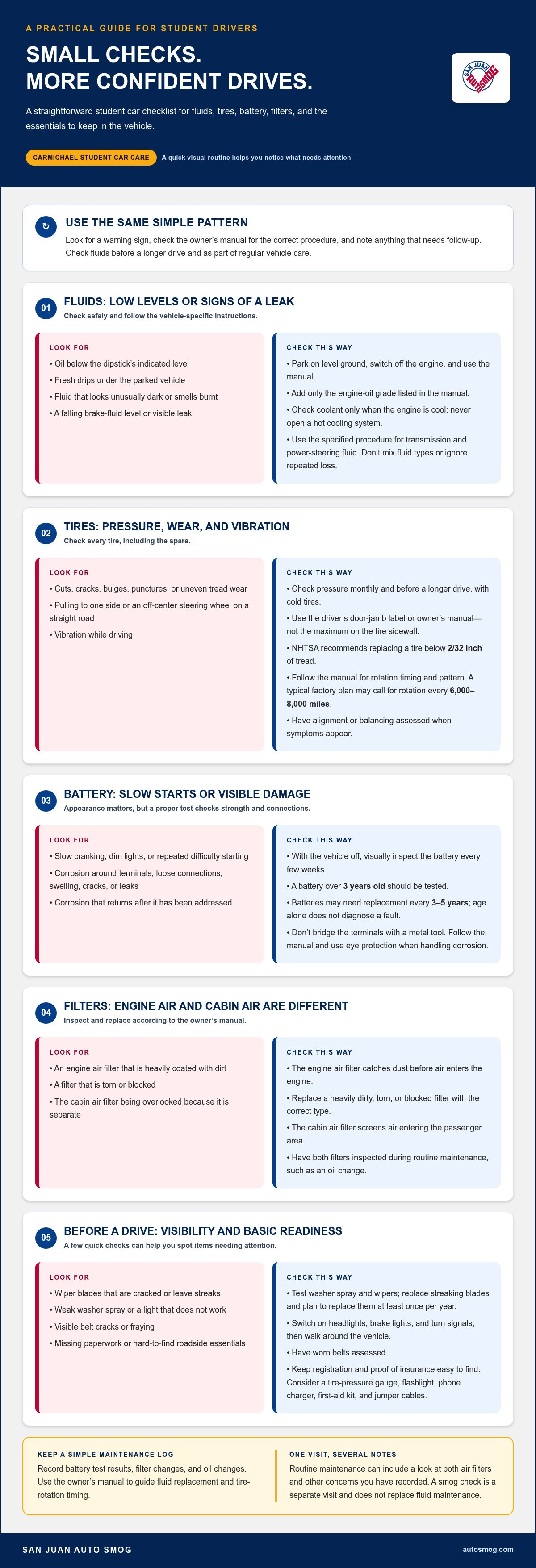
- Check fluid levels and look for leaks, then use your owner’s manual to guide service timing for coolant, transmission, brake, and power steering fluids.
- Check tire pressure and tread regularly; the National Highway Traffic Safety Administration recommends replacing a tire when its tread is less than 2/32 inch.
- Look for battery corrosion or loose connections, and check whether the engine air filter is dirty enough to need replacement.
- Keep vehicle registration and proof of insurance easy to find, and include routine oil changes in your maintenance plan.
Table of Contents
Checking coolant, transmission, brake, and power steering fluids
Check fluids before a road trip and as part of regular vehicle care. Park on level ground, switch off the engine, and follow the owner’s manual for each reservoir or dipstick. Some vehicles require a specific engine temperature or procedure, especially for transmission fluid. Look beneath the car for fresh drips, and note any fluid that looks unusually dark or smells burnt.
Check engine oil with the dipstick. If it’s low, add only the grade listed in the owner’s manual. Check coolant in its reservoir when the engine is cool, and never open a hot cooling system. Compare the brake fluid level with the reservoir markings, and watch for a falling level or visible leaks. For power steering and transmission fluid, follow the vehicle’s specified checking method. Don’t mix fluid types or treat repeated fluid loss as a problem solved by topping up.
How often should students check engine coolant, brake fluid, and windshield washer fluid? Check them before a longer drive and during routine checks. Inspect washer fluid before rainy weather or if the spray is weak. Follow the owner’s manual for fluid replacement intervals, which vary by vehicle. A student car maintenance checklist can help Carmichael students make these checks part of a regular routine.
Check washer fluid and spray the windshield to confirm the nozzles work. Inspect wiper blades for cracks or streaks; replace them if they leave streaks, and plan on replacing them at least once per year. Test headlights, brake lights, and turn signals by switching them on and walking around the vehicle. Check the battery area for corrosion, swelling, or loose connections. Before a road trip, look for visible belt cracks or fraying, and have worn belts assessed.
What routine checks can students do for battery health, lights, wipers, and belts? Inspect the battery’s visible condition, test each exterior light, run the wipers with washer fluid, and look for belt damage. This checklist can include these quick visual checks before a trip. For a California smog appointment in Carmichael, the Carmichael smog check information can help you plan that separate visit; a smog check doesn’t replace fluid maintenance.
Tire rotation and balancing
Check tire pressure monthly and before a longer drive, using a gauge when the tires are cold. Find the recommended pressure on the driver’s door-jamb label or in the owner’s manual, not the maximum printed on the tire sidewall. Adjust the pressure as needed, then inspect every tire, including the spare, for cuts, cracks, bulges, punctures, and uneven wear.
How often should students check tire pressure, tread, and alignment? Check tire pressure monthly, and inspect the tread and sidewalls at the same time. If the vehicle pulls to one side or the steering wheel sits off-center on a straight road, have the alignment assessed.
Measure tread across each tire, since uneven wear can point to pressure or alignment concerns. The National Highway Traffic Safety Administration recommends replacing a tire when its tread is less than 2/32 inch. While you’re at it, enter your VIN in NHTSA’s recall lookup to see whether any open safety recall needs a free fix. A worn edge or visible bulge also deserves attention; tread depth alone doesn’t show every condition problem.
Follow the owner’s manual for rotation timing and pattern because tire layouts differ. Rotation moves tires to different wheel positions to help manage uneven wear. A typical factory maintenance plan may call for rotation every 6,000 to 8,000 miles. Balancing corrects uneven weight around a wheel; have it assessed if you feel vibration while driving. At San Juan Auto Smog, tire rotation and a multi-point inspection that reviews tire condition are available as options with a full-synthetic oil change.
Before a flat, confirm the spare is inflated and undamaged, and locate the jack and lug wrench. Keep a tire-pressure gauge, flashlight, phone charger, and first-aid kit in the car. Jumper cables can also help if the battery fails. What basic tools and emergency supplies should students keep in their car? Start with those items, and learn how the owner’s manual explains safe jack use.
Battery checks and air filter replacement
A weak battery can show itself through slow cranking, dim lights, or repeated difficulty starting. With the vehicle parked and switched off, inspect the battery case for swelling, cracks, or leaks. Look for white or blue-green corrosion around the terminals, and check that cable connections appear secure. Don’t bridge the terminals with a metal tool.
Check the battery every few weeks for corrosion, rust, swelling, or leaks. A battery over three years old should be tested and may need replacement; batteries may need replacement every 3-5 years. Age alone doesn’t diagnose a fault, so note slow starts and ask for a battery strength and connection test when those signs appear.
Battery corrosion needs careful handling because batteries contain corrosive material. Wear eye protection, follow the vehicle manual, and don’t scrape terminals while the engine is running. If corrosion returns, a loose connection or charging issue may need attention. A proper test checks battery strength and connections, not just appearance.
The engine air filter catches dust before air enters the engine. Follow the owner’s manual for inspection and replacement. If the filter is heavily coated with dirt, torn, or blocked, replace it with the correct type. A clogged filter can reduce engine performance and fuel efficiency; replacing it helps prevent potential engine damage.
Some cars also have a cabin air filter, which helps screen air entering the passenger area. Check it separately from the engine air filter because the two serve different purposes. You can ask to have both checked as an add-on during routine maintenance, such as an oil change.
During that routine, note whether the battery starts the car reliably and whether the lights stay bright. A maintenance inspection can also include braking components, such as pads and rotors, so concerns are recorded together. Keep a simple log of battery test results, filter changes, and oil changes; it helps show when each item next needs attention.
Keeping insurance, registration, and driver's license in the vehicle
Before driving to college or school, keep your current vehicle registration, proof of insurance, and driver’s license accessible. Store paperwork in a consistent place, such as the glove compartment, and keep digital copies if your insurer or agency provides them. Review the documents before a longer trip so you can find them quickly if needed.
California drivers should keep registration and insurance information ready and complete state-mandated emissions testing under the Smog Check Program when it applies to their vehicle. The DMV smog inspection page explains when a vehicle needs one. A smog check evaluates emissions; a general maintenance inspection looks at the vehicle’s condition. They serve different purposes.
Are there free or low-cost vehicle inspection programs near Carmichael or Sacramento? A smog test is not a full vehicle-condition inspection. If your car fails a smog check, the Bureau of Automotive Repair’s Consumer Assistance Program may help income-eligible owners with emissions-related repairs or offer vehicle retirement. For a maintenance review, a multi-point inspection can help identify items needing attention. San Juan Auto Smog serves Carmichael, Sacramento, Fair Oaks, Citrus Heights, Orangevale, Gold River, and nearby communities.
Vehicle warranties don’t automatically require maintenance at a dealership. The Magnuson-Moss Warranty Act, passed in 1975 and enforced by the Federal Trade Commission, protects vehicle owners’ right to choose where they take their vehicles for maintenance without affecting warranty coverage. Keep receipts and service records, including dates, mileage, and completed work, to document maintenance.
Before a college trip, address visible damage that could affect safe driving, such as a cracked windshield that blocks your view or a loose bumper. Note unusual signs, too: rough shifting, new noises, fluid leaks, or difficulty starting. A low power steering fluid level can point to a leak, so repeated refilling isn’t a fix.
Roadside assistance may be part of an insurance policy or a separate plan, so review your coverage documents and save the contact details. Record your vehicle’s mileage at routine service intervals, such as the 30,000-mile mark, and keep maintenance paperwork together. If you want a technician to review overall condition before school travel, schedule a multi-point vehicle inspection.
San Juan Auto Smog: Full-Synthetic Oil Change
San Juan Auto Smog offers full-synthetic oil changes, with a multi-point inspection, fluid check, and tire rotation available as options. Appointments are requested for oil changes, so book ahead. Use your owner’s manual to guide oil-change timing, and note the date and mileage after each service. Each oil change includes oil and a filter, with gloves, protective seat covers, and disposable floor mats used during service. An oil change alone doesn’t ensure a vehicle will pass a California smog inspection.
If a smog check is also due, planning both services together can help you manage maintenance in one visit. A smog check evaluates emissions; an oil change addresses scheduled engine maintenance. They serve different purposes, so record both services in your vehicle’s maintenance history.
For students and families in Carmichael, a clear service record makes it easier to track what’s been completed and what comes next. Learn about Full-Synthetic Oil Changes and choose the maintenance that fits your vehicle’s schedule. Contact San Juan Auto Smog to arrange your oil change.
Make your next maintenance step easy to track
Turn the checklist into a simple record for the school year. Note the date, mileage, and any changes you notice, such as a new sound or slower starting. Bring those notes to a maintenance visit to explain what has changed and keep the conversation focused on your car’s needs.
San Juan Auto Smog is a STAR-certified Test & Repair station (license RC303707) offering full-synthetic oil changes, STAR-certified smog checks, and smog checks for 1999 and older vehicles. Smog checks on 2000 and newer vehicles don’t need an appointment, but please book ahead for 1999 and older vehicles, RVs, vans, and heavy trucks. Carmichael drivers can find directions on our Carmichael smog check page. These services address different needs, so choose based on your maintenance schedule and whether your vehicle needs emissions testing. A student car maintenance checklist for Carmichael drivers can help you keep those next steps organized without trying to remember everything at once.
When you’re ready to discuss an oil change or smog check, contact San Juan Auto Smog. A steady routine can make caring for your car feel more manageable, and each small step helps you stay informed about its condition.
Frequently Asked Questions
What Does a Typical Maintenance Service Include?
A typical maintenance service follows the vehicle manufacturer’s schedule and the work the car is due for. The technician reviews the service history, performs scheduled maintenance, and records completed work and mileage. A scheduled service is different from a repair: a new noise or warning light may need diagnosis rather than routine maintenance. Bring your owner’s manual and recent service records to help clarify what’s due.
What should a student include in a basic car maintenance checklist?
Start with engine oil and other fluid levels, tire pressure and tread, the battery and its connections, lights and wipers, the engine air filter, and current registration and proof of insurance. It also helps to distinguish routine service reminders from warning lights that may signal a problem. Check the dashboard when starting the car, then use the owner’s manual to identify unfamiliar symbols and follow its guidance. A maintenance reminder and a warning light may call for different next steps. This helps you describe an alert accurately instead of guessing what it means.
What are the recommended oil change intervals for common student cars?
Follow the oil-change interval in the owner’s manual or maintenance reminder, since the schedule depends on the vehicle and its use. A typical factory maintenance plan may call for oil changes every 5,000 to 7,500 miles. Check the manual for the required oil specification, and record the mileage after each change. Frequent short trips or heavy use may affect the manufacturer’s recommended schedule.
More articles
- How Far Ahead to Book a Used Car Check in California
- Preparing a Car for a First-Time Driver in Fair Oaks
- Oil Change in Fair Oaks, CA: Pricing & Packages
- Best Smog Check Shop Near Citrus Heights, CA
- Is There a Shop That Does Smog Check and Oil Change Together?
- How Long Does a Smog Check Usually Take?