Preparing a Car for a First-Time Driver in Fair Oaks

Preparing a car for a first-time driver in Fair Oaks starts with setting the seat, rear-view mirror, and side mirrors before the car moves. The driver should sit upright, buckle the seat belt snugly across the hips, and make a final shoulder check before changing lanes or turning. These small steps help the driver see clearly and stay properly positioned.
It’s natural to want to check that nothing important has been missed before handing over the keys. A calm, organized routine helps a new driver feel more settled and get familiar with the car before the first trip.
This guide covers mirror and seat-belt adjustments, basic safety checks, and routine maintenance. You’ll also learn what to look for around the vehicle and which checks help keep it ready for everyday driving.
Key Takeaways
- Set the driver’s seat and mirrors before starting the car so the road is easier to see.
- Check that the seat belt lies correctly across the hips and chest, without twisting or slipping under an arm.
- Consider which safety features can make everyday driving and parking easier for a new driver.
- Use a simple pre-drive routine to catch maintenance concerns before they become distractions on the road.
Table of Contents
Adjusting rear-view and side mirrors
Adjust the mirrors after the driver has settled into the seat and set the steering wheel. Mirrors positioned for one person may not give a first-time driver the same view.
Rear-View Mirror Adjustment
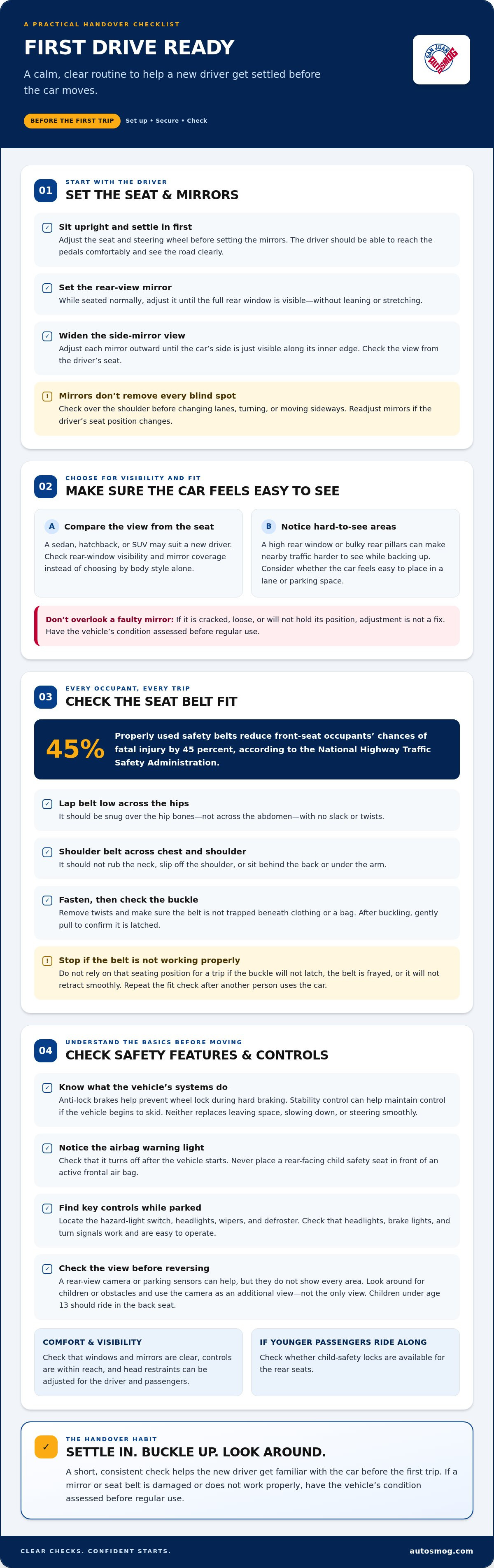
Ask the driver to sit upright and look through the rear window, then tilt the mirror until the full window appears in its reflection. The driver should see traffic behind without leaning, stretching, or moving their head from the normal driving position. If the seat position changes, adjust the mirror again.
Drivers 6 feet or taller may be able to reduce a forward blind area by turning the rear-view mirror upside down. This can raise its bottom edge about 1 to 2 inches. Try this only if the mirror remains secure and the driver can still see the full rear window.
Side Mirror Adjustment
With the driver seated normally, adjust each side mirror outward until the car’s side is just visible along the inner edge. The left mirror should show the lane beside the driver’s side, and the right mirror should show the lane beside the passenger side. This wider view helps connect what appears in the rear-view mirror with traffic approaching from either side.
Have the driver sit still while adjusting the mirrors, then check the view from that position. A passenger should not set them on the driver’s behalf. Even correctly positioned mirrors leave blind spots, so the driver must check to the sides before changing lanes, turning, or moving laterally.
A sedan, hatchback, or SUV can suit a first-time driver. Choose a vehicle that lets them sit comfortably and see clearly. Compare the rear-window view and mirror coverage from the driver’s seat instead of choosing by body style alone.
Consider visibility, blind spots, and whether the vehicle feels easy to place in a lane or parking space. For example, a high rear window or bulky rear pillars can make it harder to see nearby traffic while backing up.
If a mirror is cracked, loose, or will not hold its position, don’t treat adjustment as a fix. A Fair Oaks multi-point inspection can help assess the vehicle’s overall condition before a new driver uses it.
Proper seat-belt positioning
Before the first drive, have the new driver sit upright with their back against the seat. Properly used safety belts reduce front-seat occupants’ chances of fatal injury by 45 percent, according to the National Highway Traffic Safety Administration. A belt only works as intended when it fits the occupant and is fastened correctly.
Position the lap belt across the hips, not the abdomen. It should lie snugly over the hip bones, without slack or twists. Place the shoulder belt across the middle of the chest and over the shoulder. It should not press against the neck, slip off the shoulder, or sit behind the back or under the arm. These positions can affect how the belt restrains the body.
Use this quick check before moving the car:
- Confirm the lap portion sits low and snug across the hips.
- Check that the shoulder portion crosses the chest and shoulder.
- Remove twists and make sure the belt isn’t trapped beneath clothing or a bag.
- Fasten the buckle, then gently pull the belt to confirm it’s latched.
If the shoulder belt rubs the neck, adjust the seat or the built-in shoulder-belt guide, if equipped. Keep the driver upright rather than leaning toward the door or steering wheel to change the belt’s path. After adjusting the seat, check that the driver can still reach the pedals comfortably and see the road clearly.
Have the driver repeat the fit check after anyone else uses the car. If the buckle won’t latch, the belt is frayed, or it won’t retract smoothly, don’t rely on that seating position for a trip. A Fair Oaks multi-point inspection can help assess the vehicle’s overall condition before regular use.
Drivers should sit upright with their backs firmly against the seat when buckling up. Treat this posture as the starting point of the buckle check: settle fully back before fastening, and reset if you have shifted forward or slouched. Complete the fastening while remaining upright, with your back against the seat, rather than leaning away from it.
What safety features should a car for a first-time driver have?
Prioritize features that help a new driver maintain control, see nearby traffic, and avoid distractions. Review the owner’s manual and dashboard indicators so the driver understands each system before leaving the driveway.
Look for anti-lock brakes and electronic stability control. Anti-lock brakes help prevent wheel lock during hard braking, while stability control can help the driver maintain control if the vehicle begins to skid. These systems support careful driving, but don’t replace leaving space, slowing down, or steering smoothly.
Airbags and working seat belts are essential parts of the car’s occupant-protection system. Check that the airbag warning light turns off after the vehicle starts, and make sure the belts buckle and retract properly. Never place a rear-facing child safety seat in front of an active frontal air bag, which could cause serious injury or death if it deploys. NHTSA’s air bag safety guidance explains proper seating distance and why children under 13 belong in the back seat.
A rear-view camera or parking sensors can help reveal objects behind the vehicle, but they don’t show every area. Several hundred children are killed each year by vehicles backing up. Before reversing, check behind the car, look around for children or obstacles, and use the camera as an additional view, not the only view. If children ride in the car, remember that children under age 13 should ride in the back seat.
Consider these practical features during a test drive:
- Head restraints that can be adjusted to suit the driver and passengers.
- Clear windows and mirrors, with controls the new driver can reach easily.
- Headlights, brake lights, and turn signals that work and are easy to operate.
- Child-safety locks, if younger passengers will ride in the rear seats.
Choose a vehicle with straightforward controls. While parked, have the new driver locate the hazard-light switch, headlights, wipers, and defroster. A familiar layout makes it easier to operate these controls without taking attention from the road.
What maintenance and safety checks should be done before a new driver uses a car?
Start each trip with a walk-around. Look for flat tires, visible damage, or fluid beneath the parked car. Check that the headlights, brake lights, and turn signals work, then clear the windshield and windows. Before getting in, check the back seat, even when no passengers are expected. When preparing a car for a first-time driver in Fair Oaks, show them how to spot these issues.
Check tire pressure at least once a month. A visual check alone may not reveal an underinflated or overinflated tire. Use the pressure information on the vehicle’s door-jamb label, not the maximum pressure printed on the tire sidewall. Check tires when they’re cool, and look for damage or uneven wear.
AAA recommends inspecting under the hood once a month or as directed by the vehicle owner’s manual. With the engine off, follow the manual’s instructions to check fluid levels and look for loose or damaged components. If a warning light stays on after startup, identify the symbol before driving. Don’t guess what it means.
Use this short checklist before handing over the keys:
- Test the windshield wipers and confirm washer fluid sprays onto the glass.
- Check that windows provide a clear view and mirrors remain secure.
- Make sure the horn, headlights, and turn signals respond to their controls.
- Remove loose items from the driver’s footwell so they can’t interfere with the pedals.
- Confirm the parking brake releases fully before moving.
Follow the owner’s manual for maintenance intervals and warning-light guidance. A multi-point inspection in Fair Oaks can help identify maintenance concerns before regular use. This is a practical step, especially if the vehicle’s service history is unclear. It’s also worth entering the VIN in NHTSA’s recall lookup so any open safety recall can be fixed before the new driver takes over, and the California DMV’s teen driver tips are a helpful companion for new drivers and parents. Address concerns involving visibility, tires, braking, or controls before the first trip.
Make checking the interior a deliberate part of the entry routine: look through the back seat before getting in rather than assuming it is clear. Check tire pressure once a month as part of regular maintenance. Since appearance alone cannot confirm proper inflation, use a pressure check instead of relying on a glance.
San Juan Auto Smog: Full-Synthetic Oil Change
San Juan Auto Smog offers full-synthetic oil changes, with a multi-point inspection, fluid check, and tire rotation available as options. Appointments are requested for oil changes, so book ahead. Before a new driver uses the vehicle regularly, review its maintenance records and owner’s manual for the next oil service. Regular maintenance supports engine performance and reliability, but an oil change alone does not ensure a vehicle will pass a smog inspection. During every oil change, the team uses gloves, protective seat covers, and disposable floor mats.
If the vehicle is also due for California emissions testing under the Smog Check Program, San Juan Auto Smog is a STAR-certified Test & Repair station (license RC303707) and offers STAR-certified smog checks. The DMV smog inspection page explains when a vehicle needs one. Keeping up with both routine service and required testing helps you stay organized without treating one as a substitute for the other. For older cars, older-vehicle smog checks are available for 1999 and older vehicles. Smog checks on 2000 and newer vehicles don’t need an appointment, but please book ahead for 1999 and older vehicles, RVs, vans, and heavy trucks. See smog checks in Fair Oaks for hours and directions.
Review the household car’s maintenance needs, then learn about San Juan Auto Smog’s full-synthetic oil changes. Contact the shop to plan your next step.
Make Good Car-Care Habits Part of the First Drive
Preparing a car for a first-time driver in Fair Oaks can also build a useful habit: involving the driver in routine care. Invite them to review the owner’s manual, keep maintenance records together, and report unfamiliar sounds or dashboard warnings promptly. These small responsibilities help them understand the vehicle, not just its controls.
For families in Fair Oaks, Carmichael, Sacramento, Citrus Heights, Orangevale, Gold River, and nearby communities, a simple next step is to agree on who tracks upcoming service and how the driver should report concerns. Clear expectations help keep vehicle care organized as driving becomes part of everyday life.
For help with the vehicle’s maintenance needs, contact San Juan Auto Smog today. A little preparation and shared attention can help a new driver build confidence and responsible habits from the start.