High-Mileage Vehicle Inspection in Fair Oaks: What to Check and Why

A familiar car can be dependable and still leave you wondering what deserves attention next. If you plan to keep driving it, a high mileage vehicle inspection Fair Oaks drivers can use helps turn general uncertainty into an organized maintenance plan.
It’s reasonable to want clear guidance without feeling that every recommendation means immediate work. Your vehicle’s service history, how you use it, and the questions you bring to the inspection can all make the discussion more useful.
This guide explains what an inspection can cover, how to prioritize findings, and how to connect inspection results with routine care. You’ll also learn what information to bring so your next maintenance decisions feel more informed and manageable.
Key Takeaways
- A high mileage vehicle inspection Fair Oaks drivers can use creates a practical snapshot of current condition, not a prediction of how long a vehicle will last.
- A multi-point inspection can assess brakes, fluids, and OBD-II information, but its findings apply to the items checked and have limits.
- Sort findings into safety concerns, maintenance needs, and items to monitor so you can plan next steps without treating every recommendation as urgent.
- San Juan Auto Smog has served older and high-mileage vehicles in Fair Oaks since 2018 and is a STAR-certified Test & Repair station (license RC303707).
Table of Contents
What Does a High-Mileage Vehicle Inspection in Fair Oaks Help You Understand?
A high-mileage vehicle inspection is a snapshot of the vehicle’s condition on the day it’s checked. It can establish a maintenance baseline: a record of inspected items and concerns to address or monitor. It isn’t a prediction of how long the vehicle will last, and it can’t guarantee that every developing issue will be found.
Mileage is only one part of the picture. A well-maintained vehicle with higher mileage may be in better condition than a lower-mileage vehicle with deferred care. Service records, driving patterns, age, and visible wear all help explain what may need attention. A multi-point inspection in Fair Oaks can organize these observations into a useful starting point for ongoing care.
Why can a high-mileage vehicle benefit from a condition check?
Parts wear at different rates, and an odometer can’t show whether fluids have been changed or brakes have been checked. A condition check can document the items examined and identify concerns that may need follow-up. The findings help you plan maintenance based on observations, your vehicle’s history, and the manufacturer’s schedule, rather than mileage alone.
How does an inspection differ from a smog check?
A maintenance inspection focuses on the condition of selected vehicle components. It may include brakes, fluids, and an OBD-II check, which reads information from the vehicle’s onboard diagnostic system. A smog check evaluates emissions under California’s program; it isn’t a general assessment of the vehicle’s overall mechanical condition. San Juan Auto Smog is a STAR-certified Test & Repair station (license RC303707), so if a vehicle fails, the shop can diagnose and repair it too. The Bureau of Automotive Repair Smog Check program explains how testing works. A pre-purchase inspection has a different purpose: it helps a prospective buyer assess a vehicle before buying, while a maintenance inspection supports care of a vehicle you already own.
What Can a High-Mileage Vehicle Inspection Check?
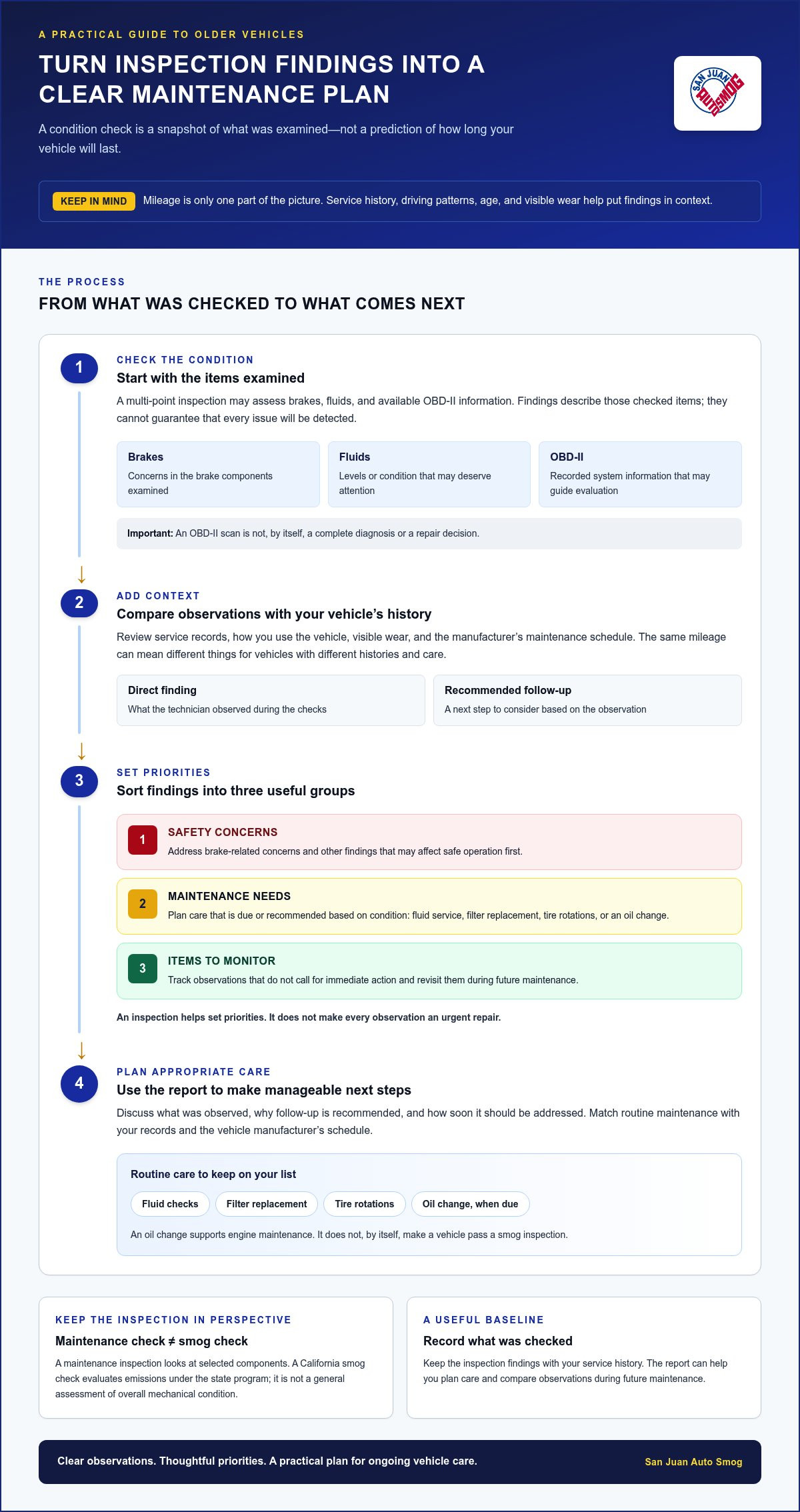
A multi-point inspection can include checks of the brakes, fluids, and OBD-II system. These checks help describe the condition of the items assessed, but results are limited to what was inspected and can’t guarantee that every issue will be detected. Use the inspection as a starting point for planning, not as a promise that the vehicle has no other concerns.
In short, an inspection can assess brake condition, fluid condition, and available OBD-II information. A high mileage vehicle inspection Fair Oaks owners arrange can turn those observations into clear next steps while keeping direct findings separate from recommended follow-up.
What can brake and fluid checks tell you?
A brake check can help identify concerns in the brake components examined. Fluid checks can show whether fluid levels or condition may deserve attention; they don’t replace the service recommendations in your owner’s manual. If braking feels different or an inspection identifies a concern, a Fair Oaks brake check can help clarify the finding. Include tire condition in your overall safety review, and use NHTSA tire safety guidance for general tire-care information.
What can an OBD-II inspection contribute?
OBD-II is the vehicle’s onboard diagnostic system. A scan can provide information the vehicle has recorded about certain systems, which may help guide further evaluation. That information isn’t, by itself, a complete diagnosis or a repair decision. A technician can explain what was observed, whether follow-up is appropriate, and how the information fits with the vehicle’s symptoms and maintenance history.
Ask for findings to be explained as observations and recommendations. This makes it easier to distinguish a concern that needs prompt attention from routine care or an item to monitor.
How Should You Prioritize High-Mileage Vehicle Inspection Findings?
A vehicle can feel normal to drive and still have wear that deserves attention. Warning lights report certain detected conditions; their absence doesn’t confirm that every system is in good shape. Use the inspection findings and your service history together to decide what needs attention, what belongs in routine maintenance, and what can be monitored.
A useful priority list separates findings into three groups:
- Safety concerns: Address brake-related concerns and other findings that may affect safe operation first.
- Maintenance needs: Plan care that is due or recommended based on condition, such as fluid service, filter replacement, tire rotations, or an oil change.
- Items to monitor: Keep track of observations that don’t call for immediate action, and revisit them during future maintenance.
Inspection findings help set maintenance priorities. They don’t make every observation an urgent repair.
What should you address first after an inspection?
Start with safety-related recommendations, especially concerns involving the brakes. It’s also worth checking your VIN for open safety recalls with the NHTSA recall lookup. Review the report with the technician and ask what was observed, why follow-up is recommended, and how soon it should be addressed. A clear explanation helps you make an informed plan. One finding may call for further evaluation or timely care, while another may simply need monitoring. The report should help distinguish between them.
How does routine maintenance support long-term care?
Compare maintenance recommendations with your records and the vehicle manufacturer’s schedule. Fluid checks, filter replacement, and tire rotations can help keep routine care organized. If an oil change is due, a full-synthetic oil change can be part of that plan. San Juan Auto Smog offers full-synthetic oil changes, with a multi-point inspection, fluid check, and tire rotation available as options. The oil change includes oil and a filter staged before you arrive, along with gloves, protective seat covers, and disposable floor mats. An oil change alone does not make a vehicle pass a smog inspection; it supports engine maintenance, not an emissions test result.
A high mileage vehicle inspection Fair Oaks owners use is most helpful when its findings become a practical care plan. Schedule an optional multi-point inspection to review your vehicle’s condition and plan appropriate next steps.
Where to Get a High-Mileage Vehicle Inspection in Fair Oaks
San Juan Auto Smog provides vehicle inspections and maintenance support for older and high-mileage vehicles in Fair Oaks. A multi-point inspection can help you organize the items checked and decide what to address, schedule, or monitor. The goal is to give you clear information so you can make informed choices about your vehicle’s care.
What can local owners expect from the inspection process?
Technicians assess selected areas of the vehicle and discuss what they observed and what follow-up may make sense. Bring your service records and note any questions you’d like answered. For drivers in Fair Oaks and nearby communities, including Carmichael, Sacramento, Citrus Heights, Orangevale, and Gold River, a Fair Oaks multi-point inspection can help organize the next steps in caring for a familiar vehicle.
Can you pair an inspection with preventive maintenance?
Use the findings alongside your service records and the vehicle manufacturer’s maintenance schedule. If an oil change is due, consider including it in your routine care. Fluid checks, filter replacement, or tire rotations may also fit your needs. For a smog check in Fair Oaks, San Juan Auto Smog is a STAR-certified Test & Repair station (license RC303707). Smog checks on 2000 and newer vehicles don’t need an appointment, but please book ahead for oil changes and for smog checks on 1999 and older vehicles, RVs, vans, and heavy trucks. The DMV smog inspection page explains when a smog check is required.
San Juan Auto Smog also offers pre-purchase and pre-sale inspections, along with preventive maintenance services to help you keep track of your vehicle’s condition.
Make Your Next Maintenance Decision With Confidence
A simple record can make future care easier. Keep inspection findings with your service history, note when recommended maintenance is completed, and write down any changes you notice while driving. That context can help you discuss new concerns clearly and avoid relying on memory when it’s time to plan the next visit.
A high mileage vehicle inspection Fair Oaks drivers arrange is a practical next step when they want a clearer starting point for caring for a familiar vehicle. Use the findings to plan maintenance at a manageable pace and revisit monitored items during future checks. The goal isn’t to predict the car’s future, but to make informed decisions as its condition changes.
Ready to review your vehicle’s condition? Schedule a high-mileage vehicle inspection with San Juan Auto Smog at 4701 San Juan Ave in Fair Oaks and make a clear plan for your next maintenance steps. Text (916) 961-6009 to make an appointment.
Frequently Asked Questions
Should I get a high-mileage vehicle inspected if it seems to run normally?
An inspection can be useful if you don’t have complete service records or recently bought the vehicle. Before the visit, gather receipts and write down anything you’ve noticed, such as a change in steering feel, an unfamiliar sound, or a fluid spot where you park. These details give the technician useful context and help you ask focused questions.
What does a high-mileage vehicle inspection include?
A multi-point inspection can cover brakes and fluids, and may include a review of OBD-II information from the vehicle’s onboard diagnostic system. The specific items checked depend on the inspection. Ask the technician to distinguish direct observations from suggestions for further evaluation, and keep the findings with your maintenance records so you can refer to them at your next service visit.
Can a vehicle inspection predict how much longer my car will last?
No inspection can give an exact end date for a vehicle’s useful life. For a more helpful picture over time, keep inspection notes and service receipts together. At later visits, those records can help you see whether an item has changed, remained consistent, or received maintenance. This supports informed decisions without relying on a precise lifespan estimate.
Does an oil change help a high-mileage car pass a California smog check?
No, an oil change alone doesn’t ensure a passing result. Keep oil service on the schedule recommended in your owner’s manual, and treat a required emissions test as a separate step. San Juan Auto Smog is a STAR-certified Test & Repair station (license RC303707). If you have a test coming up, bring any recent maintenance or emissions-related service records for context.
Where can I get a high-mileage vehicle inspection in Fair Oaks?
San Juan Auto Smog in Fair Oaks offers multi-point inspections for owners who want help planning care for an older vehicle. Before your visit, gather available maintenance records and note any questions you want answered. You can schedule an inspection through the contact page or by texting (916) 961-6009 and bring those notes along to help make the visit useful and straightforward.
More articles
- Smog Certificate Cost: What Really Drives the Price
- Ford F-150 Maintenance Service in Citrus Heights
- San Juan Auto Smog vs Californiaemissionscheck: A Fair Comparison
- Weekend Oil Change Appointments in Orangevale
- Where to Get a Diesel or RV Smog Check Near Sacramento
- When to Rotate Camry Tires and Change Filters