Ford F-150 Maintenance Service in Citrus Heights

A dashboard reminder is more than a prompt to change the oil; it’s part of a practical plan for catching maintenance needs early. For a 2023 Ford F-150, change the engine oil and filter at each interval shown on the instrument cluster, don’t exceed one year between oil changes, and reset the reminder afterward. Ford F-150 maintenance service in Citrus Heights can also include checks of other maintenance items due for your truck.
It can be hard to know whether a warning means “schedule routine service” or points to a problem that needs attention. The right maintenance plan starts with your truck’s model year, service history, dashboard reminders, and how you use it.
This guide explains how oil-life monitoring works, what preventive maintenance may involve, and how service checks can help spot concerns before they become harder to address. You’ll also learn what to consider when arranging maintenance in Citrus Heights, including fluid, brake, tire, and filter checks alongside an oil change.
Key Takeaways
- Note new noises, changes in how the truck drives, or visible leaks, and share when you first noticed them during service.
- Use the schedule for your F-150’s model year to plan fluid and component maintenance. For a 2023 model, brake fluid is due every 3 years.
- For a 2023 F-150, plan for engine coolant replacement at 10 years or 200,000 miles (320,000 km), whichever comes first.
- Keep mileage-based maintenance on your calendar: track spark plug replacement at the interval your engine’s schedule lists, and accessory drive belt replacement every 100,000 miles (160,000 km) on the 2023 schedule.
Table of Contents
Early detection of vehicle problems
Early clues often appear before a Ford F-150 develops a clear failure. Notice new sounds, changes in steering, warning lights, fluid spots, or unusual smells. A squeal during braking differs from a knock over bumps. Write down when each change happens, such as during a cold start, a turn, or highway driving. Note whether the truck was carrying a load. These details help a technician narrow the inspection and compare symptoms with visible findings.
Check the ground where your truck is parked for fresh fluid spots. After starting it, note any dashboard warning that stays illuminated. Pay attention to changes in braking or engine response, and look for uneven tire wear. A symptom that recurs in the same conditions is useful information. Avoid guessing at the cause. Describe what you hear, see, or feel, when it began, and whether it has changed.
Before choosing an F-150 repair shop in Citrus Heights, check whether staff will explain inspection findings in plain language. Ask how they document the concern, identify the next step, and separate urgent issues from maintenance that can be planned. Clear answers help you make an informed decision without approving work based on a vague symptom alone.
Two useful things to ask about any visit are when the truck will be ready and which findings need attention now. For your own visit, bring prior service records and a brief symptom list. Mention recent changes, such as a new vibration after tire work or a warning light that appeared during a commute.
After an inspection, ask which finding relates to the symptom and what evidence supports that conclusion. A visible leak, worn part, or stored warning may help guide the next diagnostic step. Keep the findings with your maintenance records. If the same sound or warning returns, note the driving conditions again. These observations help track changes and make follow-up conversations more focused.
Before any visit, it’s also worth checking for open safety recalls on your truck’s VIN with the NHTSA recall lookup. Recall repairs are handled by Ford dealers at no cost.
Ford F-150 service
Plan F-150 service around the model year, mileage, records, and dashboard reminders. For Ford F-150 maintenance service in Citrus Heights, begin with the schedule for your truck’s exact model year, which you can find in the owner’s manual or through Ford’s owner manual lookup.
San Juan Auto Smog is at 4701 San Juan Ave in Fair Oaks, a short drive from Citrus Heights, and is open Monday through Friday from 8 AM to 6 PM and Saturday and Sunday from 9 AM to 6 PM. Share your F-150’s model year and service needs when you book. Text (916) 961-6009 to make an appointment.
Mileage and Model-Year Maintenance
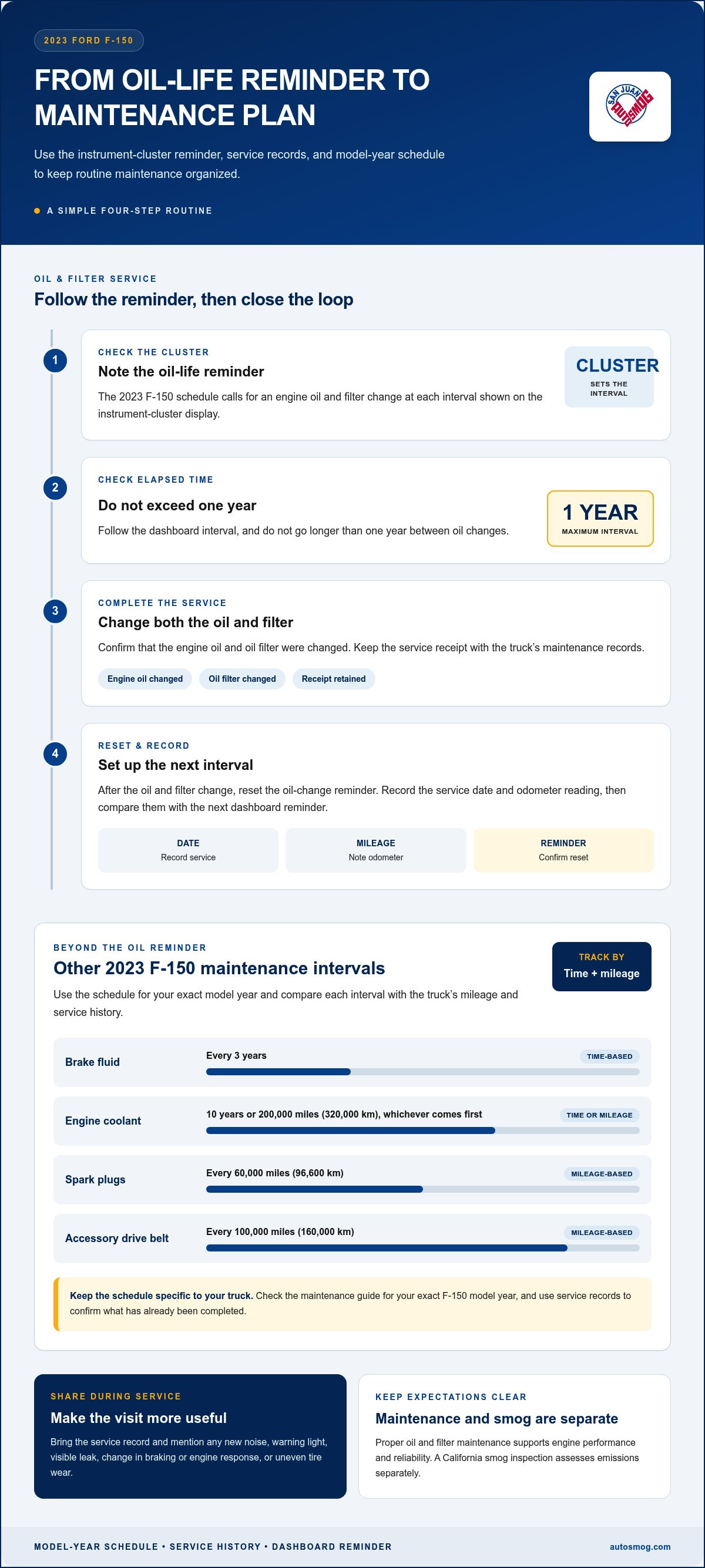
Use the maintenance schedule for your exact F-150 model year, not one for a newer or older truck. For a 2023 F-150, brake fluid replacement is due every 3 years. Engine coolant replacement is due at 10 years or 200,000 miles (320,000 km), whichever comes first. Compare the odometer and service records with each interval, and note completed work. This keeps model-specific maintenance easier to track.
Scheduling and Same-Day Appointments
To arrange service in Citrus Heights, book ahead by text at (916) 961-6009 or through the contact page. Provide the model year, current mileage, requested maintenance, and any warning or symptom. Same-day times depend on the schedule and the work requested, so ask about timing when you book. A clear description helps the shop plan the visit and identify relevant inspection steps.
Ford warranty and prepaid maintenance coverage depends on the written agreement. Review covered services, mileage or date limits, eligibility terms, and record-keeping requirements. Keep invoices and service dates with the F-150’s maintenance history.
Hybrid, PowerBoost, and electric-component work requires capability suited to the specific system and task. Describe the concern clearly so the shop can determine whether its service scope matches the work.
For a broader condition review alongside scheduled service, an optional multi-point inspection can help organize findings across key vehicle areas.
Oil changes and oil-life monitoring
Your F-150’s oil-life monitor helps time routine service. For a 2023 model, Ford’s schedule says to change the engine oil and filter at each interval indicated by the instrument cluster display. The schedule also says not to exceed one year between oil-change intervals. Follow the display and track elapsed time. Both reminders help you plan around the truck’s recommended maintenance.
The oil-life monitor is a prompt, not a replacement for your truck’s maintenance schedule. Record the date and mileage after each oil change, then compare them with the next dashboard reminder. If you don’t remember when the last service took place, check previous invoices or maintenance records. A written log helps track completed work and the next interval.
After changing the oil and filter, reset the oil-change reminder. The 2023 Ford F-150 schedule specifically calls for that reset. An unchanged reminder can make the next interval harder to track. At your visit, confirm that both the oil and filter were changed, and keep the receipt with the truck’s records.
- Note the dashboard reminder and current odometer reading.
- Compare the reminder with your last service record.
- Record the date, mileage, oil change, and filter replacement.
- Confirm the reminder was reset after service.
For scheduled maintenance, an oil change service can be planned around your F-150’s model-year schedule and dashboard reminder. Use the visit to share any maintenance concerns and keep the service record with your truck’s history.
Proper oil and filter maintenance supports engine performance and reliability. It doesn’t determine a California smog result. If you’re not sure when your truck needs a smog check, the DMV smog inspection page explains the requirements. A smog inspection assesses emissions separately, so treat testing as a distinct service. Your F-150’s records and dashboard reminders provide a practical basis for planning its next maintenance visit.
Preventive maintenance
Preventive maintenance means completing the work listed for your F-150’s model year before overdue items accumulate. Use the owner’s maintenance schedule, odometer, and service records together. Ford owners should have maintenance performed at the times recommended for their vehicle. A truck’s age, mileage, and documented service history help you identify the next scheduled task.
Follow your engine’s maintenance schedule when planning spark plug replacement, since the interval can differ by engine. The 2023 schedule calls for accessory drive belt replacement every 100,000 miles (160,000 km). These are separate mileage intervals, so record each task independently. Check invoices for completed work before treating an item as due again.
Keep a simple maintenance record with the service date, odometer reading, work completed, and next listed interval. For example, save the invoice after spark plug replacement and note the mileage. At later visits, compare your record with the maintenance schedule. This helps distinguish completed work from tasks that still need planning.
- Keep the F-150’s maintenance schedule with service records.
- Write down mileage when a scheduled item is completed.
- Track spark plug and accessory drive belt intervals separately.
- Note any new leak, noise, or change in vehicle operation.
A visual check can provide useful context between scheduled services. While the truck is parked, look for belt damage, loose-looking connections, or fluid spots. Don’t attempt work beyond your comfort or equipment. Instead, note what you saw and where it appeared, then discuss the observation alongside your maintenance record during service.
For an organized review of vehicle condition, arrange a multi-point inspection. Ask for findings to be grouped by immediate concern and planned maintenance. That written picture can help you prioritize the next steps without losing track of mileage-based work.
San Juan Auto Smog: Full-Synthetic Oil Change
San Juan Auto Smog offers full-synthetic oil changes, with a multi-point inspection, fluid check, and tire rotation available as options. The oil change includes oil and a filter for F-150 owners who are due for scheduled oil service; book ahead on the oil change page or by text. Bring your truck’s model year, current mileage, and recent maintenance records so the service can align with its schedule and oil-life reminder. A smog check is a separate service; an oil change alone does not determine whether a truck passes California emissions testing.
If your F-150 is also due for emissions testing, combining a STAR-certified smog check for Citrus Heights drivers with routine oil service can help you organize both needs in one visit. San Juan Auto Smog is a STAR-certified Test & Repair station (license RC303707), so if a truck fails, the shop can diagnose and repair it too. Smog checks on 2000 and newer vehicles don’t need an appointment, but please book ahead for oil changes and for smog checks on 1999 and older vehicles, RVs, vans, and heavy trucks. The Bureau of Automotive Repair Smog Check program explains how testing works. Staying current with maintenance supports engine performance and long-term emissions-system health, but it cannot guarantee a smog result.
For help with your F-150’s oil service or smog check, contact San Juan Auto Smog. Text (916) 961-6009 to make an appointment.
Make Your Next Service Visit Count
Give your next visit a clear purpose by deciding what you want to understand before service begins. You might want to discuss a new concern, clarify which maintenance item comes next, or create a manageable plan for upcoming care. A focused conversation can help turn a single visit into a useful starting point for future decisions.
For Ford F-150 maintenance service in Citrus Heights, choose the question that matters most to you and share it when arranging service. You can contact San Juan Auto Smog about your next visit or text (916) 961-6009 and explain what you’d like help with. A thoughtful next step can make caring for your truck feel more organized and manageable.
More articles
- San Juan Auto Smog vs Californiaemissionscheck: A Fair Comparison
- Weekend Oil Change Appointments in Orangevale
- Where to Get a Diesel or RV Smog Check Near Sacramento
- When to Rotate Camry Tires and Change Filters
- Power Steering Fluid Top-Off in Fair Oaks: How to Check and Add Fluid
- How Much Should a Smog Check Cost in California?