Why the DMV Sent You to a STAR Station for a Smog Check

A STAR referral tells you where your smog check must happen, not that your vehicle has failed. If you’re wondering why the DMV sent you to a STAR station, your registration notice directs you to a station in California’s STAR program. STAR-certified stations meet state performance standards and can inspect vehicles, including those identified as high-polluting.
It’s understandable to wonder whether the referral signals a problem. By itself, it doesn’t tell you the test result. This guide explains what the STAR requirement means, how to read a pass or failure, how long a smog certificate is valid, and what to do if your vehicle doesn’t pass.
You’ll also learn what happens during a smog check and how routine maintenance supports vehicle reliability. An oil change isn’t a smog repair and can’t guarantee a passing result, but it can help you keep up with regular vehicle care while addressing your inspection needs.
Key Takeaways
- Use your DMV notice to understand whether your vehicle is directed to a STAR station and what inspection it needs.
- Learn which vehicle details affect smog-check requirements before you make an appointment.
- Prepare for the inspection by gathering the paperwork and vehicle information that can make your visit smoother.
- Know how to locate a STAR station and consider pairing the visit with routine maintenance that supports your vehicle’s long-term care.
Table of Contents
Which vehicles are required to get a STAR smog inspection?
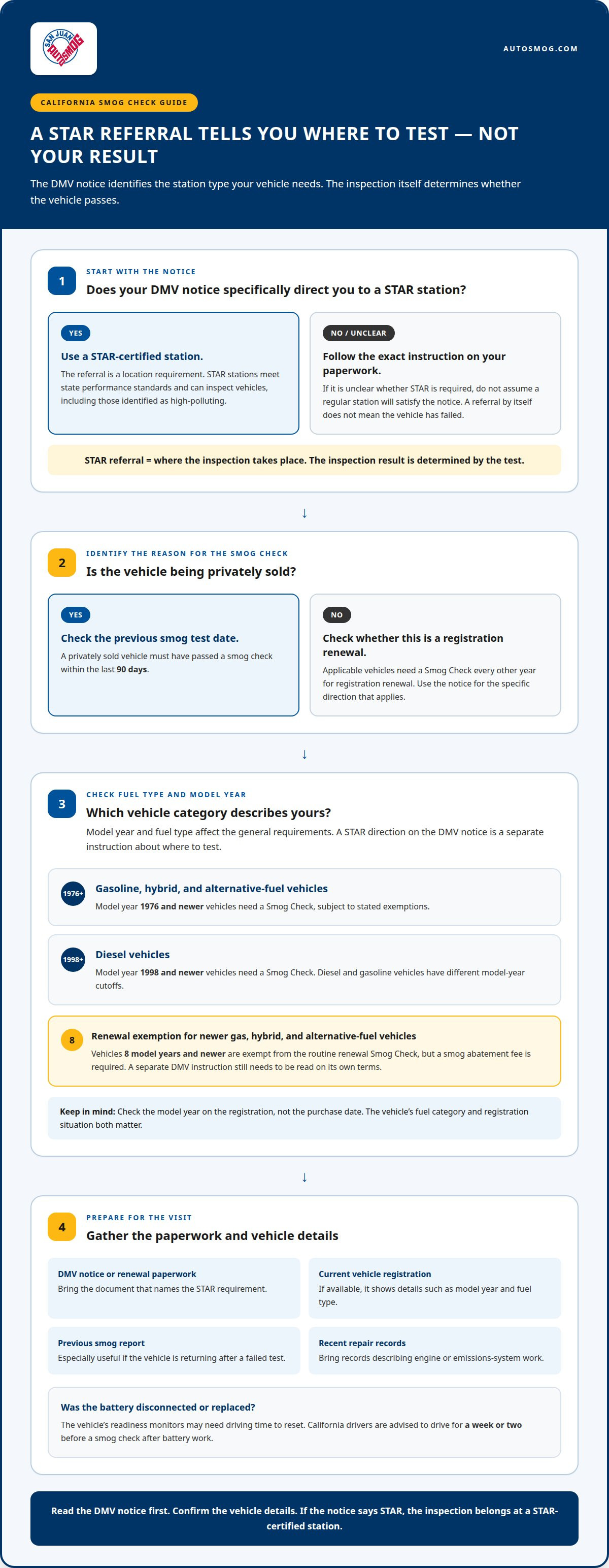
California smog requirements depend on factors such as model year, fuel type, and registration situation. A STAR referral is a separate instruction about where to test. Your DMV notice tells you whether the vehicle must go to a STAR station. A vehicle may need a smog check without every station being STAR-certified, so age alone doesn’t explain every referral.
In California, gasoline, hybrid, and alternative-fuel vehicles from model year 1976 and newer need a Smog Check, subject to stated exemptions, according to the California Bureau of Automotive Repair. The fuel category matters because diesel vehicles have a separate cutoff. Check your registration for the vehicle’s model year, rather than relying on the purchase date. If the notice directs you to STAR, follow that station requirement even when your vehicle fits a broad category.
According to the California Bureau of Automotive Repair, diesel vehicles from model year 1998 and newer need a Smog Check. That rule differs from the gasoline, hybrid, and alternative-fuel cutoff. For example, a diesel vehicle and a gasoline vehicle from the same model year may fall under different requirements. Use the fuel type and model year together when reviewing your registration notice.
Registration renewal is another deciding factor, and the DMV smog inspection page explains when renewal requires one. The California Bureau of Automotive Repair says applicable vehicles need a Smog Check every other year for registration renewal. Gasoline, hybrid, and alternative-fuel vehicles that are eight model years and newer are exempt from that renewal check, but a smog abatement fee is required. An exemption from a routine renewal test doesn’t automatically explain a separate DMV instruction, so read the notice’s specific direction.
A sale can also create a smog requirement. The California Bureau of Automotive Repair says a privately sold vehicle must have passed a smog check within the last 90 days. Before completing a private sale, check the test date and whether the certificate meets that rule. If your notice names STAR, the practical next step is to arrange the inspection at a STAR station, not assume any smog station will satisfy the referral.
Can I get a smog check at a regular station instead of a STAR station?
If your DMV notice directs you to STAR, choose a STAR-certified station for the inspection. A regular smog station may not meet the specific direction on your notice. STAR-certified stations meet state performance standards and can inspect vehicles, including those identified as high-polluting. The referral concerns where the inspection takes place, not whether your vehicle has failed. Read the notice carefully before arranging the test, especially if it specifies a station type.
STAR and regular stations aren’t interchangeable for every DMV-directed test. A STAR-certified station is authorized to test vehicles under the STAR program, which includes vehicles that may produce higher emissions. A referral can be part of the state’s inspection process; it doesn’t mean your vehicle has already failed or needs repairs. The result comes from the actual inspection.
Use these steps to avoid choosing the wrong station:
- Read your registration notice and locate any instruction naming STAR.
- Check that the station you plan to visit is identified as STAR-certified.
- Bring the notice so the station can see the DMV’s specific direction.
If the notice doesn’t clearly say whether STAR is required, don’t assume a regular station will satisfy it. The key is the referral on your paperwork, not whether a station generally performs smog tests. A vehicle may have a location requirement in addition to needing a smog check. Keep the DMV instruction handy when arranging the test and explain that your registration directs you to a STAR-certified station.
Before setting out, compare the station’s displayed name and address with the location you selected. A listing for a business may include several service details, so confirm you have the correct site and its STAR designation. Keep your DMV notice accessible during the visit. These simple checks help you follow the referral and avoid arriving at a station that doesn’t match it.
What should I bring to a STAR station inspection?
Bring the DMV notice that directed you to a STAR station. It identifies the required inspection and helps clarify the referral. Bring your current vehicle registration, too, if available. It shows identifying details such as model year and fuel type, which can help distinguish requirements for gasoline and diesel vehicles.
Keep these items together before you leave:
- The DMV notice or registration renewal paperwork naming the STAR requirement.
- Your vehicle registration, if you have it available.
- A previous smog report, especially if you are returning after a failed test.
- Repair records that describe recent work on the engine or emissions system.
Previous test results and repair records provide useful context, but they don’t replace the new test. If an earlier report lists a diagnostic trouble code or emissions result, bring the full report rather than relying on memory. Those details can help you understand what changed between inspections. If you recently bought the vehicle (see change-of-ownership smog checks), any maintenance records you received can also explain its service history.
Prepare the vehicle, too. Make sure the person bringing it knows how to start it and has the keys. If the battery was disconnected or replaced, allow time for the vehicle’s readiness monitors to reset. California drivers are advised to drive for a week or two before a smog check after battery work. These monitors are part of the vehicle’s emissions self-checks and may need driving time to complete.
Before leaving, compare the notice with the vehicle. Check the license plate and vehicle details, then keep the paperwork somewhere easy to find. If the notice says STAR, bring it even if you’ve had smog checks elsewhere. Preparing this information helps the station match your vehicle to the right inspection and explain the result clearly.
How do I find a STAR-certified station near me
Start with the California Bureau of Automotive Repair’s station locator. Select the STAR station option, then enter your city or ZIP code. For example, a Fair Oaks driver can search nearby locations before choosing a station. This narrows the results to locations that match the STAR instruction on the DMV notice.
Compare business names and addresses to find a convenient location. A station in Carmichael or Sacramento may be easier to reach than one farther away. Check the STAR status in each listing: a station that performs smog checks isn’t automatically STAR-certified. Match the location to the requirement on your registration notice.
Review the station listing to see which vehicle types it handles. This matters if you drive an older vehicle, RV, van, or heavy truck. Search results can include stations with different inspection capabilities. Choose a location that suits both your vehicle and the STAR direction on your paperwork.
Use these steps to organize your search:
- Open the California Bureau of Automotive Repair station search.
- Select the STAR station filter or designation.
- Enter your city or ZIP code, such as Fair Oaks or Citrus Heights.
- Compare the listed address with your route and DMV instructions.
If the first search is inconvenient, try another nearby community while keeping the STAR designation selected. Drivers in Orangevale, Gold River, or Carmichael can broaden the location search. Don’t choose by distance alone: the station must be STAR-certified and able to inspect your vehicle type.
Once you find a suitable listing, save the station’s name and address with your DMV notice. Bring the notice to the inspection so the station can see the referral. Before leaving, compare the saved address with the location you plan to visit. This check helps prevent confusion between similarly named locations and keeps your visit aligned with the DMV instruction.
San Juan Auto Smog: Full-Synthetic Oil Change
San Juan Auto Smog can handle your STAR inspection and routine oil service in one visit. If your vehicle is due for an oil change, pairing it with a Full-Synthetic Oil Change can help you stay current on preventive maintenance. An oil change doesn’t guarantee a smog pass or repair an emissions fault. It supports engine performance and routine vehicle care. San Juan Auto Smog offers full-synthetic oil changes, with a multi-point inspection, fluid check, and tire rotation available as options.
Choose the inspection that matches your vehicle and DMV notice. San Juan Auto Smog is a STAR-certified Test & Repair station (license RC303707) and offers STAR-Certified Smog Checks, Older Vehicle Smog Checks for 1999 and older, RV, van, and heavy truck smog inspections, and gross polluter smog checks. If a vehicle fails, the shop can diagnose and repair it too. For drivers in Fair Oaks and nearby communities, combining services can make the visit more convenient while keeping inspection and maintenance needs organized.
Smog checks on 2000 and newer vehicles don’t need an appointment, but please book ahead for oil changes and for smog checks on 1999 and older vehicles, RVs, vans, and heavy trucks. Contact San Juan Auto Smog at 4701 San Juan Ave in Fair Oaks to arrange your smog check or oil change. Text (916) 961-6009 to make an appointment.
Make Your Next Visit Count
If you’re still wondering why the DMV sent you to a STAR station, let the notice guide your next step. Keep it with your vehicle records so you can refer to it when arranging the inspection or planning maintenance. A smog visit can also be a useful time to consider your vehicle’s overall care, especially if you drive an older or high-mileage car. Routine maintenance supports reliability, but it doesn’t replace diagnosing an emissions problem or guarantee a passing result.
San Juan Auto Smog can help with your STAR inspection and ongoing vehicle care, including a Full-Synthetic Oil Change. Choose the service that fits what your vehicle needs now, without treating maintenance as a one-time task. If you’re ready to plan your next step, contact San Juan Auto Smog. Text (916) 961-6009 to make an appointment. A clear plan can make vehicle care feel more manageable, and you can take it one visit at a time.
Frequently Asked Questions
What does a DMV STAR station do?
A STAR station tests your vehicle and records its smog result. If the vehicle passes, the inspection produces a smog certificate for the registration process. Keep the result with your vehicle records, especially if you’re handling a sale or registration renewal. In California, a smog certificate is valid for 90 days, so its date matters when you use it for a transaction.
Why would the DMV refer a vehicle to a STAR station?
The reason depends on the registration instruction assigned to your vehicle. If you’re asking, “Why did the DMV send me to a STAR station?” check your notice for the specific action required. Use the vehicle details on the paperwork when arranging the test. This helps ensure the inspection result is associated with the correct vehicle and registration matter.
What is a STAR smog check in California?
A STAR smog check is a California emissions inspection performed through the state’s STAR program. It produces a test result, and a passing result provides a smog certificate. The certificate is separate from your registration paperwork, so keep both available. If you need the certificate for a sale or registration task, its issue date helps determine whether it remains valid.
How can I tell whether my DMV notice requires a STAR station?
Read the smog instructions on your notice and look for the word “STAR.” Match the vehicle information there with your registration paperwork before arranging the test. If you’re still asking why the DMV sent you to a STAR station, focus on the exact wording of the notice rather than guessing from the vehicle’s age or condition. Keep the notice handy during the inspection.
What happens if my vehicle fails a STAR smog inspection?
Use the test report to understand what needs attention before planning repairs. Note the specific result or system identified, and keep the report with any repair records. Avoid replacing parts based on guesswork; the failure reason should guide diagnosis. Once the cause is addressed, the vehicle can be tested again. At a STAR-certified Test & Repair station, the same shop can handle
More articles
- Fair Oaks auto maintenance for busy parents: Find a trusted garage
- Smog Inspection Cost: What Fair Oaks Drivers Actually Pay
- Smog Test Price in California: What Sets the Cost
- How to Set a Sacramento Car Maintenance Budget for Your Vehicle
- Smog Certificate Cost: What Really Drives the Price
- High-Mileage Vehicle Inspection in Fair Oaks: What to Check and Why