Smog Check for Heavy Vehicles: California Requirements and Local Testing

Does your truck need a smog check, CARB’s Clean Truck Check, or another emissions test? The answer depends on details such as its weight, fuel type, and registration. A smog check for heavy vehicles starts with identifying which California requirements apply to your specific truck. CARB’s Clean Truck Check generally covers diesel and alternative-fuel vehicles over 14,000 pounds GVWR that operate on California public roads. Gasoline-powered vehicles are exempt from that program.
This guide explains how to find the right official requirements, what to prepare before testing, and how heavy-truck inspections differ from standard smog checks. San Juan Auto Smog in Fair Oaks, a STAR-certified Test & Repair station (license RC303707), provides heavy-truck smog inspections by appointment for drivers in nearby Sacramento-area communities. Routine maintenance supports a truck’s reliability and emissions-system health, but an oil change alone won’t make a vehicle pass an emissions test.
Key Takeaways
- For a smog check for heavy vehicles, identify the vehicle’s category and applicable California program before arranging testing.
- Use CARB’s current guidance to confirm your truck’s Clean Truck Check deadlines and testing requirements.
- Before an inspection, review any CARB notice, note the vehicle’s identifying details, and gather relevant registration and program correspondence.
- San Juan Auto Smog, a STAR-certified Test & Repair station, provides heavy-truck smog inspections by appointment in Fair Oaks, serving Carmichael, Sacramento, Citrus Heights, Orangevale, and Gold River.
Table of Contents
Does Your Heavy Vehicle Need a California Smog Check?
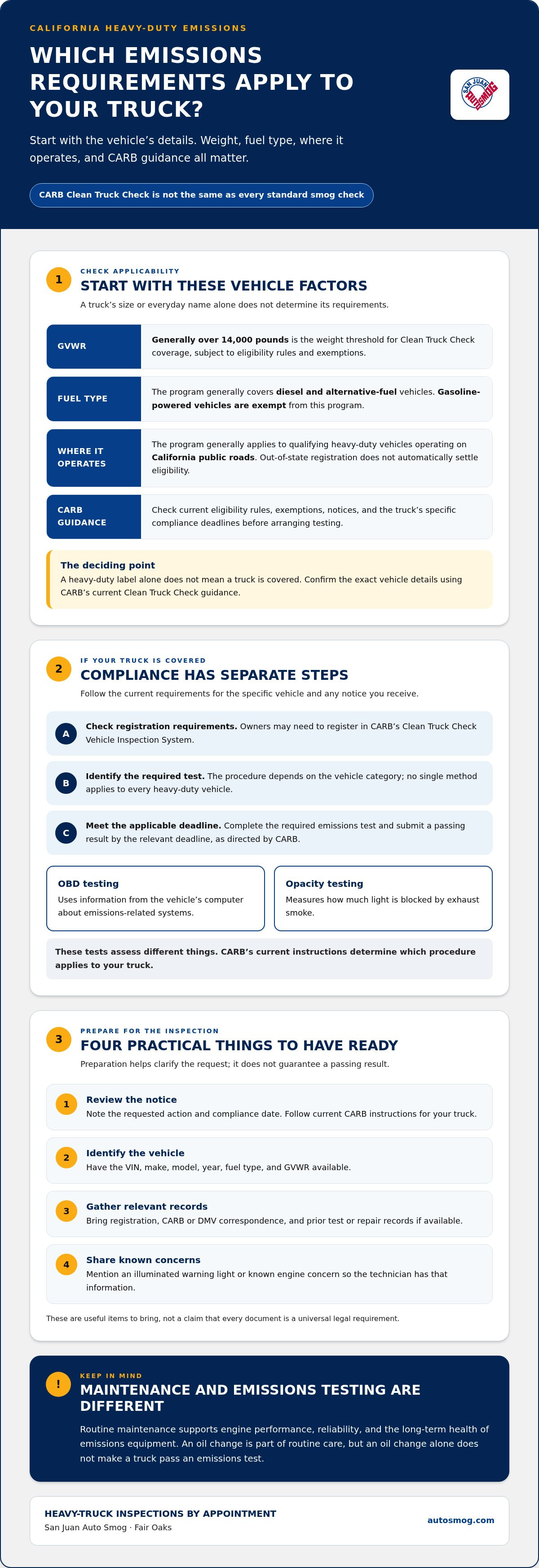
A truck’s size or everyday description doesn’t determine which California emissions rules apply. Start with its GVWR, fuel type, where it operates, and any CARB notice or account information. These details help distinguish a standard smog check from the state’s separate heavy-duty program and point you to the right requirements.
Clean Truck Check is CARB’s Heavy-Duty Inspection and Maintenance (HD I/M) program for qualifying heavy-duty vehicles that operate on California public roads. It isn’t another name for every smog check. The program generally covers diesel and alternative-fuel vehicles over 14,000 pounds GVWR, but exemptions and other eligibility rules matter. It is also separate from the Bureau of Automotive Repair’s smog check program for vehicles subject to that program.
How do California heavy-truck requirements differ by vehicle?
Two trucks that look alike can have different requirements because their weight ratings, fuel types, engines, emissions systems, or operating circumstances differ. California’s Clean Truck Check generally covers qualifying diesel and alternative-fuel vehicles over the GVWR threshold, while gasoline-powered vehicles are exempt from this program. For a smog check for heavy vehicles, use the vehicle’s records and CARB’s current eligibility guidance, not a fleet nickname or a broad “truck” label. Check CARB’s current instructions for vehicle-specific deadlines as well.
Is a heavy truck automatically subject to Clean Truck Check?
No. A heavy-duty label alone does not establish that the program applies. CARB’s criteria determine whether a specific vehicle is covered, and exemptions can affect the answer. Out-of-state registration doesn’t automatically settle the question either: qualifying vehicles registered elsewhere may still be covered when they operate on California public roads. Review CARB’s current Clean Truck Check guidance using the truck’s exact details before arranging testing.
How Clean Truck Check Testing Works for Subject Vehicles
For a covered truck, program compliance and the inspection are related but separate steps. Owners may need to register in CARB’s Clean Truck Check Vehicle Inspection System, meet program requirements, complete the required emissions test, and submit a passing result by the applicable deadline. The inspection procedure depends on the vehicle’s category. CARB explains current requirements through California’s Clean Truck Check program.
Match the test to the vehicle and its applicable CARB requirements, because no single testing method applies to every heavy-duty vehicle. A general smog-check label doesn’t tell you which procedure is required. Review CARB’s current instructions before booking, especially if a notice names a specific test or action.
What is the difference between OBD testing and opacity testing?
On-board diagnostics, or OBD, refers to information from a vehicle’s computer about its emissions-related systems. An opacity test measures how much light is blocked by exhaust smoke. These methods assess different things, and neither is a universal test for all heavy vehicles. The applicable procedure depends on the truck’s category and current program rules. CARB materials can help you identify the required test before arranging an appointment.
What should owners verify in a CARB notice?
Read the notice alongside the truck’s records. Check that the vehicle identification details match, note the required action and compliance date, and look for instructions about submitting test results. If the notice and your records don’t seem to match, use current CARB guidance rather than relying on an old summary. Keep the notice handy when arranging a heavy-truck smog inspection, so the testing request is clear. For passenger-vehicle Smog Check rules, see the BAR Smog Check program; for registration holds tied to emissions compliance, see the DMV smog inspections page.
San Juan Auto Smog provides heavy-truck smog inspections by appointment. Technicians can discuss maintenance observations, but the inspection result depends on the applicable test and the vehicle’s condition. An oil change is separate routine maintenance and doesn’t guarantee a passing emissions test.
How to Prepare a Heavy Truck for a Smog Inspection
A little preparation can make a heavy-truck inspection easier to organize. For a smog check for heavy vehicles, use the notice and vehicle records to clarify what test or action applies. These steps help you arrive with useful information, but they don’t guarantee a passing result.
- Review the notice. Note the requested action and any compliance date. The Senate Bill 210 (SB 210) background may help explain the program, but follow current CARB instructions for your truck.
- Identify the vehicle. Have its VIN, make, model, year, fuel type, and GVWR available so the inspection can be matched to the correct vehicle.
- Gather records. Collect relevant registration, CARB or DMV correspondence, and prior test or repair records if available.
- Arrange an appointment. San Juan Auto Smog performs heavy-truck inspections by appointment in Fair Oaks.
What should you bring to a heavy-truck smog appointment?
Bring the vehicle’s registration and any relevant DMV or CARB notice, along with previous test results or repair records if you have them. These documents help identify the truck and provide context. They’re practical items to bring, not a claim that every document is a universal legal requirement. If a warning light is on or you know of an engine concern, mention it so the technician has that information.
Can routine maintenance help before testing?
Good maintenance supports engine performance, reliability, and the long-term health of emissions equipment. An oil change can be part of routine care, but an oil change alone doesn’t make a truck pass an emissions test. Take note of known concerns and understand that only the applicable inspection can determine the result.
To organize a heavy-truck inspection by appointment, contact San Juan Auto Smog.
Arrange a Heavy-Truck Smog Inspection Near Fair Oaks
San Juan Auto Smog performs heavy-truck smog inspections by appointment in Fair Oaks. The shop serves drivers from Carmichael, Sacramento, Citrus Heights, Orangevale, and Gold River, making it a local option for owners planning an inspection. Because the required procedure depends on the vehicle and applicable rules, have your CARB notice or other relevant information ready when arranging your visit.
What happens when you arrange an inspection?
When scheduling, share the truck’s identifying details and explain whether you received a CARB or DMV notice. Bring relevant vehicle records and the notice to the appointment. This helps clarify what you’re seeking, though the findings depend on the truck and the applicable test. Review the shop’s smog check services as you plan. Heavy-truck inspections are by appointment, so schedule before bringing the vehicle in.
What maintenance should heavy-truck owners consider too?
Keep emissions testing and routine maintenance as separate items on your vehicle-care list. San Juan Auto Smog offers full-synthetic oil changes, with a multi-point inspection, fluid check, and tire rotation available as options. An oil change is routine service, not a way to make a truck pass an emissions test. Staying current with scheduled maintenance supports engine performance, reliability, and the long-term health of emissions equipment. A multi-point inspection, available as an option, can also help you keep track of general maintenance needs. Technicians can discuss what they observe, but no maintenance service guarantees a passing test.
If you’re in Fair Oaks, Carmichael, Sacramento, Citrus Heights, Orangevale, or Gold River, schedule your heavy-truck smog inspection with San Juan Auto Smog by appointment. Bring relevant CARB correspondence so the visit can be organized around your vehicle’s information.
Make a Clear Plan for Your Truck’s Next Inspection
Turn the applicable rule into a clear plan for your specific truck. Keep the VIN, registration, CARB notice, and prior test information together, then use current CARB guidance to confirm the vehicle’s requirements and deadline. Organized records make it easier to arrange the inspection and explain any known warning lights or engine concerns.
A smog check for heavy vehicles is one part of responsible ownership, not a substitute for tracking the truck’s wider maintenance needs. After testing, keep the result with your service records and note any maintenance observations to address separately. If routine service is due, plan it according to the vehicle’s maintenance schedule. This gives you a useful record as you manage the truck’s ongoing care.
Ready to take the next step? Schedule a heavy-truck smog inspection with San Juan Auto Smog in Fair Oaks. Drivers from Carmichael, Sacramento, Citrus Heights, Orangevale, and Gold River can arrange an appointment and bring any relevant CARB correspondence.
Frequently Asked Questions
Does every heavy truck in California need a Clean Truck Check?
No. Check the truck’s Clean Truck Check status in CARB’s Vehicle Inspection System and compare the listed vehicle information with your records, rather than relying on its job or body style. If the portal details appear inconsistent, resolve that discrepancy with CARB before assuming a test is due. This gives you a vehicle-specific starting point instead of guessing from appearance.
How often does a heavy-duty vehicle need a Clean Truck Check test?
As of October 2026, most covered heavy-duty vehicles must test twice a year. Starting October 1, 2027, OBD-equipped vehicles must test quarterly under the current schedule. These are program-wide rules, not a substitute for checking the schedule assigned to your truck. Use CARB’s current materials to verify the next due date rather than relying on an older fleet calendar.
Can an out-of-state truck be subject to California Clean Truck Check?
Yes. For an out-of-state vehicle subject to the program, CARB bases compliance deadlines on the last digit of the VIN. Keep the VIN and any CARB notices together so you can identify the relevant deadline and track submitted test results. Registration in another state doesn’t replace checking the California program’s current instructions for that vehicle.
What happens if a heavy truck fails an emissions inspection?
A failed result doesn’t by itself explain what repair is needed. Review the test report and follow CARB’s instructions for addressing the result and submitting any required follow-up test. Keep records of the report and subsequent work. Failure to comply with Clean Truck Check requirements can lead to a DMV registration hold or financial penalties, so use CARB’s guidance to understand the next steps.
Can I get a heavy-truck smog inspection near Fair Oaks?
Yes. San Juan Auto Smog in Fair Oaks arranges heavy-truck inspection appointments. CARB allows a passing test to be submitted up to 90 days before the compliance deadline, so owners may be able to plan ahead rather than wait until the due date. Check the truck’s current deadline, then schedule with enough time to manage any required follow-up.