Looking for a Low Cost Smog Check Near You?
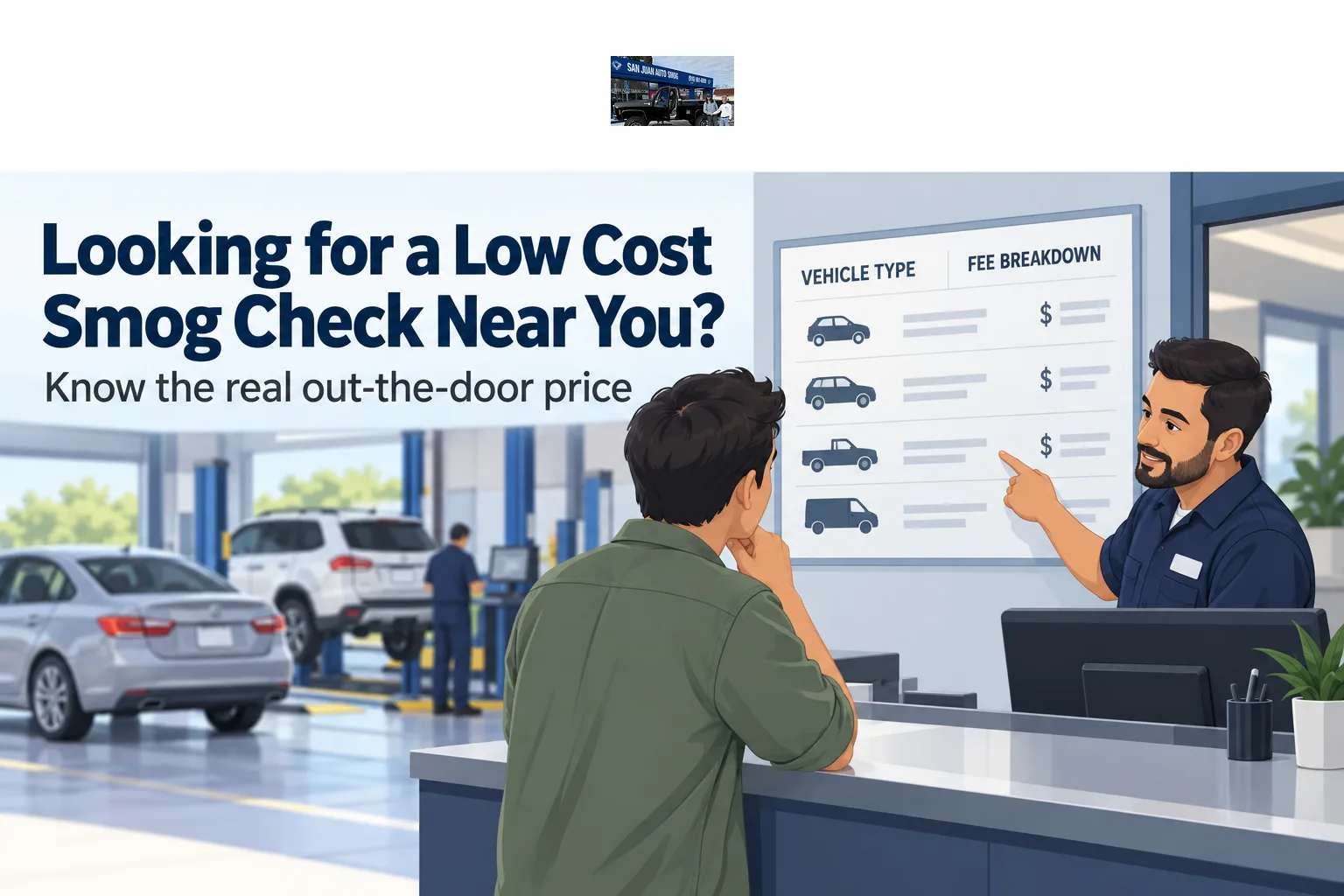
A low cost smog check near you is one where the price matches your actual vehicle type, you pass on the first try, and nothing gets added at the counter. That's a different question than "cheapest advertised number," because a rock-bottom price that doesn't apply to your car, or that excludes certificate fees, isn't actually low cost once you're standing there paying.
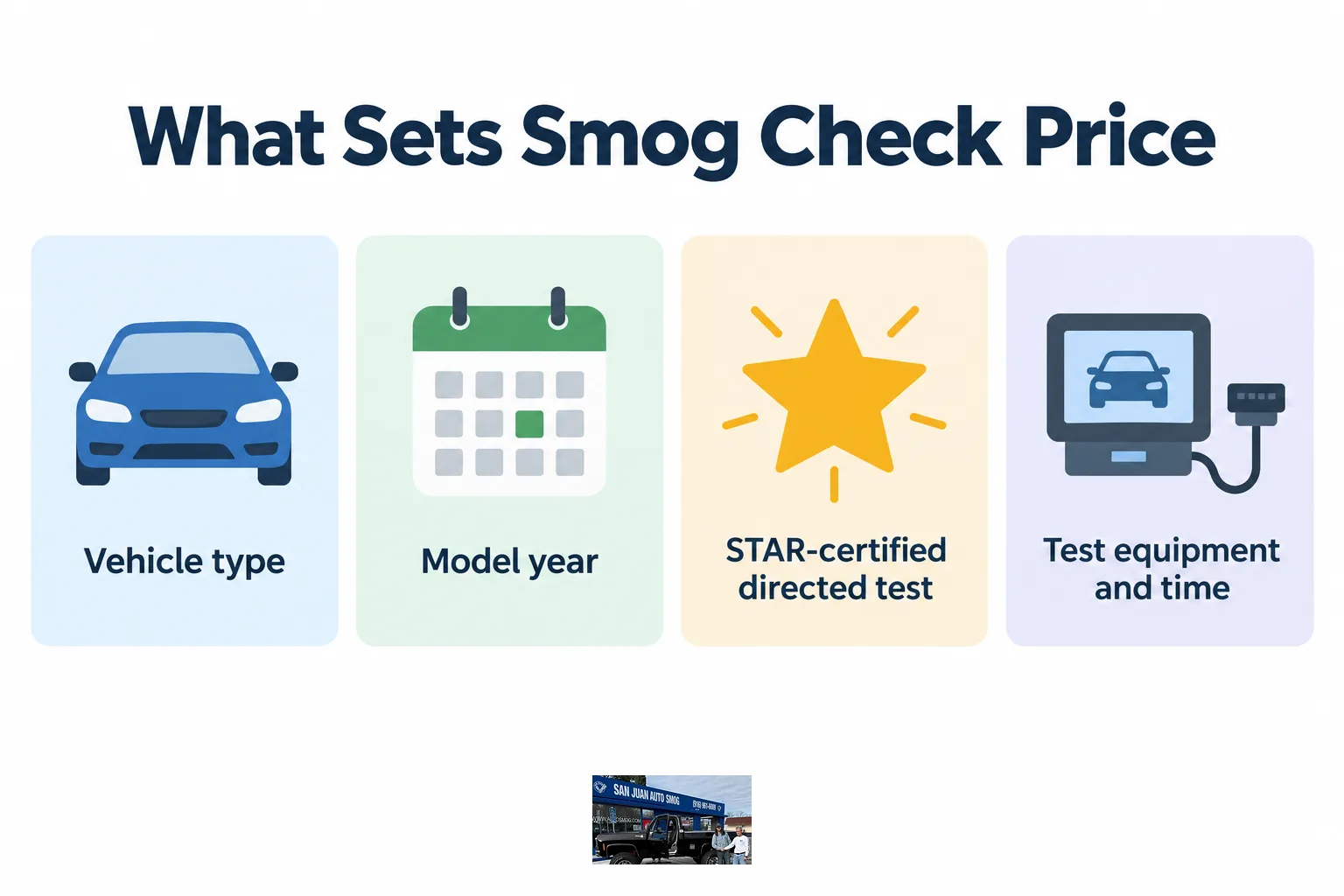
Price on a smog test depends on vehicle type, model year, and whether your car needs a STAR-certified station for a directed test. The fastest way to stop guessing is to ask a shop directly what your specific vehicle will cost before you drive over.
Key Takeaways
- The lowest real-world price is the one that matches your vehicle type and doesn't require a second visit.
- STAR certification isn't optional if your DMV renewal notice specifies it, regardless of price.
- Bundling a smog check with an oil change in one visit typically costs less than booking each separately — see the smog + oil combo coupon for an example of how that's structured.
- A free retest within a set window, for 2000-and-newer vehicles, protects you from paying twice if a small issue causes a fail.
- Walk-in availability for newer vehicles removes the scheduling cost of taking time off work for an appointment that may not be needed.
Table of Contents
What Actually Sets the Price of a Low Cost Smog Check?
Price is driven by vehicle type, model year, and test type, not by the shop's marketing. A standard gas vehicle from 2000 or newer usually tests faster and cheaper than an RV, diesel truck, or a pre-2000 vehicle that needs a different protocol. Shops that advertise one flat number for every car are either rounding up for simple vehicles or underquoting for complex ones.
Why do quotes vary so much between stations?
Because the test itself varies. A directed STAR-only test, a diesel opacity test, or an older-vehicle tailpipe test all take different equipment and time, and the fee reflects that. Asking for a quote by vehicle type, rather than comparing a generic "starting at" price, gets you a number you can actually hold a shop to.
Does a lower price ever mean a lower-quality test?
Not if the station is STAR-certified, since the state sets the testing standard regardless of price. What a low price can sometimes skip is the retest guarantee or combo savings, so it's worth asking what's included before you assume one quote beats another.
How Do You Find the Lowest Real-World Cost Near You?
Compare the total cost of the visit, not just the quoted test fee. That means factoring in certificate and state fees, whether a retest is covered if your car fails, and whether you can combine the smog check with something you already need, like an oil change.
- Confirm your vehicle's category first. A 2000-or-newer car, a pre-1999 vehicle, and an RV or diesel truck are priced and scheduled differently, so start there.
- Ask if the station is STAR-certified. If your DMV renewal notice specifies a STAR station, a non-STAR quote is irrelevant no matter how low it is.
- Ask what happens on a fail. A free retest within a defined window for newer vehicles can save an entire second test fee.
- Ask about bundling. If an oil change is also due, a combined visit is often priced lower than booking the two separately.
- Get the number in writing or by text. A quoted price by vehicle type avoids a surprise at pickup.
Should You Bundle Smog and Oil Change to Cut Cost?
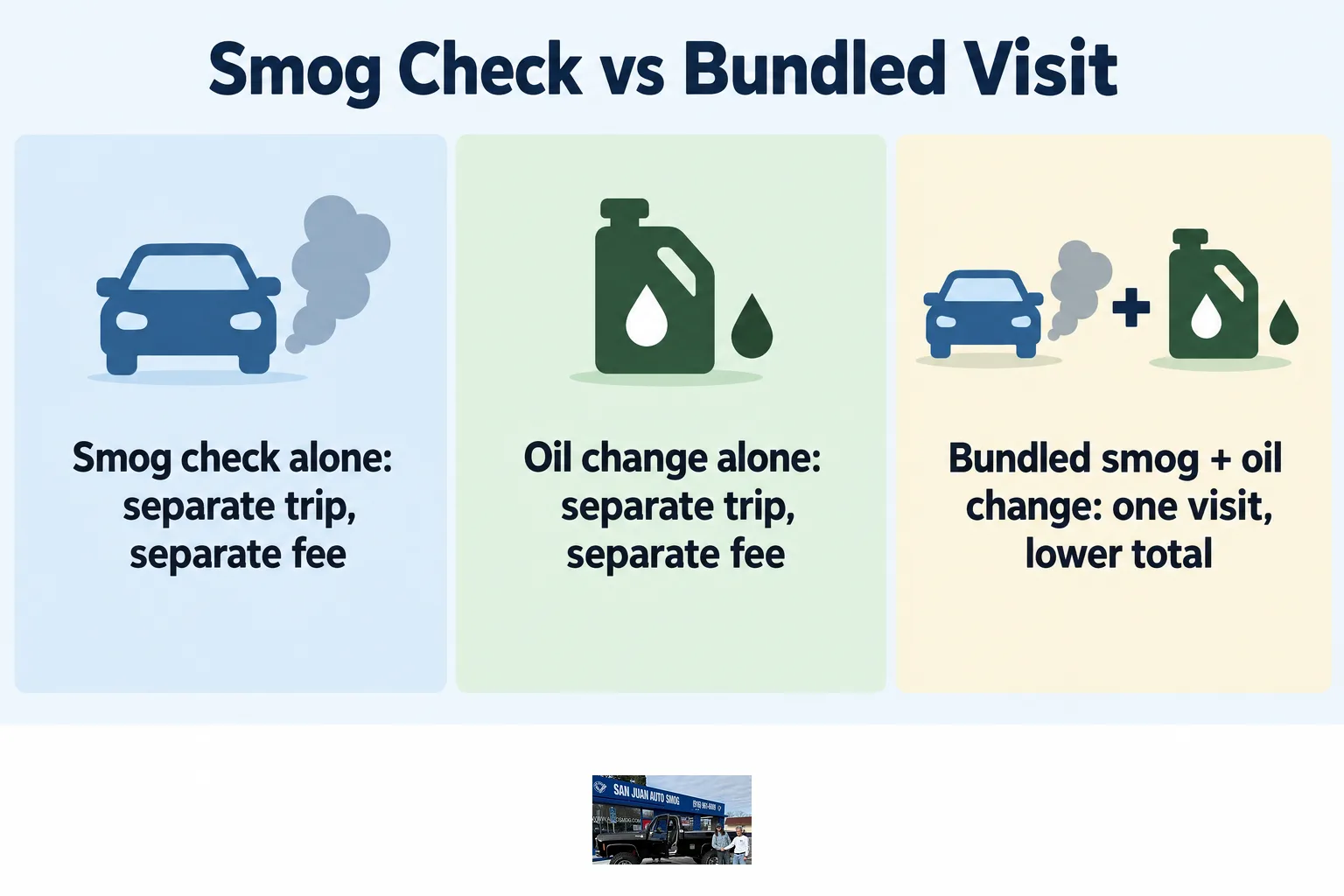
Bundling usually lowers the total you pay for both services in one visit. If your vehicle is due for an oil change around the same time as a smog test, doing both in one appointment saves a second trip and is typically priced lower than booking them apart.
What if you only need the smog check right now?
Then book just that — a STAR-certified test with walk-in availability for 2000-and-newer vehicles doesn't require you to add anything else. Save the combo for whenever the oil change is actually due.
What Hidden Costs Should You Watch For?
The two most common surprises are certificate/state fees and a retest that isn't actually free. A quoted test price sometimes excludes the state certificate fee, which is separate and non-negotiable. And promotional pricing can carry exclusions, so a combo coupon, for instance, is generally one per visit and won't stack with other offers.
What about older vehicles, RVs, and diesels?
These usually need an appointment rather than a walk-in slot, since the test and equipment differ from a standard gas-vehicle check. If you drive a motorhome, van, or heavy truck, confirming appointment availability ahead of time avoids a wasted trip.
Take the Next Step on Your Smog Check
San Juan Auto Smog is a STAR-certified smog check station in Fair Oaks, CA, serving Carmichael, Sacramento, Citrus Heights, Orangevale, and Gold River, with transparent pricing by vehicle type and no guessing at the counter. Walk-ins are welcome for 2000-and-newer vehicles, and an appointment is recommended for 1999-and-older cars, RVs, vans, heavy trucks, and oil changes. The shop has completed more than 35,000 services since 2018 and is rated 4.7 from 2,122 reviews across platforms.
If your vehicle qualifies, a passing 2000-or-newer car also comes with a free retest within 60 days, so one failed attempt doesn't mean paying twice. For an exact number on your vehicle, text or call, or start with the STAR-certified smog check page to see what applies to your car.
Frequently Asked Questions
Is the cheapest smog check always the best deal?
Not necessarily. The lowest advertised price can exclude certificate fees, skip a retest guarantee, or apply only to a vehicle category different from yours. Compare the total out-the-door cost, not just the headline number.
Do I need a STAR-certified station for a low cost smog check?
If your DMV renewal notice specifies a STAR station or directed test, yes — a non-STAR shop's price doesn't apply to you regardless of how low it is. Check your renewal notice before comparing quotes.
Can I combine a smog check and oil change to save money?
Yes, booking both in one visit is typically cheaper than scheduling them separately, and it saves a second trip to the shop. Ask whether the combo pricing can be combined with other coupons before booking, since it's usually one discount per visit.
Is a retest free if my newer vehicle fails?
For 2000-and-newer vehicles, a free retest within 60 days is common, except on certain promotional pricing that excludes it. Confirm the retest policy before you pay for the original test.
Do older vehicles, RVs, and diesels cost the same as a regular car?
No, these typically require different test equipment and an appointment rather than a walk-in, which affects the price. Ask for a quote specific to your vehicle type rather than assuming a standard car price applies.