Smog Check Open on Sunday Near Fair Oaks: What to Know
A smog check open on Sunday near Fair Oaks does exist at some stations, but Sunday hours are set shop by shop, not by any statewide rule, so the only way to know for certain is to check the specific station before you drive over. California's Bureau of Automotive Repair licenses STAR stations and sets testing standards, but it does not dictate operating hours. That means two stations a mile apart can have completely different weekend schedules.
If your DMV renewal is due and Sunday is the only day you have free, you still have options that do not depend on finding a weekend slot.
Key Takeaways
- Sunday hours are set by each shop individually, so confirm them directly rather than assuming.
- A 2000-or-newer vehicle can usually be tested as a walk-in on a weekday, which removes the pressure to find weekend hours at all.
- Older vehicles, RVs, and heavy trucks need an appointment regardless of the day, so check the older vehicle smog check page before you plan around a weekend.
- DMV renewal deadlines are calendar dates, not business-day dates, so testing a few days early avoids last-minute scrambling.
- Combining your smog check with an oil change in one visit can save you a second trip later in the week.
Table of Contents
Why isn't Sunday smog testing available everywhere?
Smog stations set their own hours, and many choose not to open on Sunday because testing volume is lower that day. STAR certification from California's Bureau of Automotive Repair governs who is allowed to perform directed emissions tests, but it says nothing about when a station has to be open. Staffing, equipment calibration schedules, and local demand all factor into a shop's decision to run a weekend shift.
Does every STAR station close on Sunday?
No. Some do stay open, particularly in areas with heavy walk-in traffic. The only reliable way to know is to check a station's posted hours or call ahead, since hours can also change seasonally.
What should you do if you need a smog check this weekend?
If Sunday hours fall through, a weekday walk-in is often faster than waiting for the next weekend. For 2000-and-newer vehicles, walk-in testing is common at STAR stations, which means a weekday lunch break or an early morning before work can cover it without an appointment.
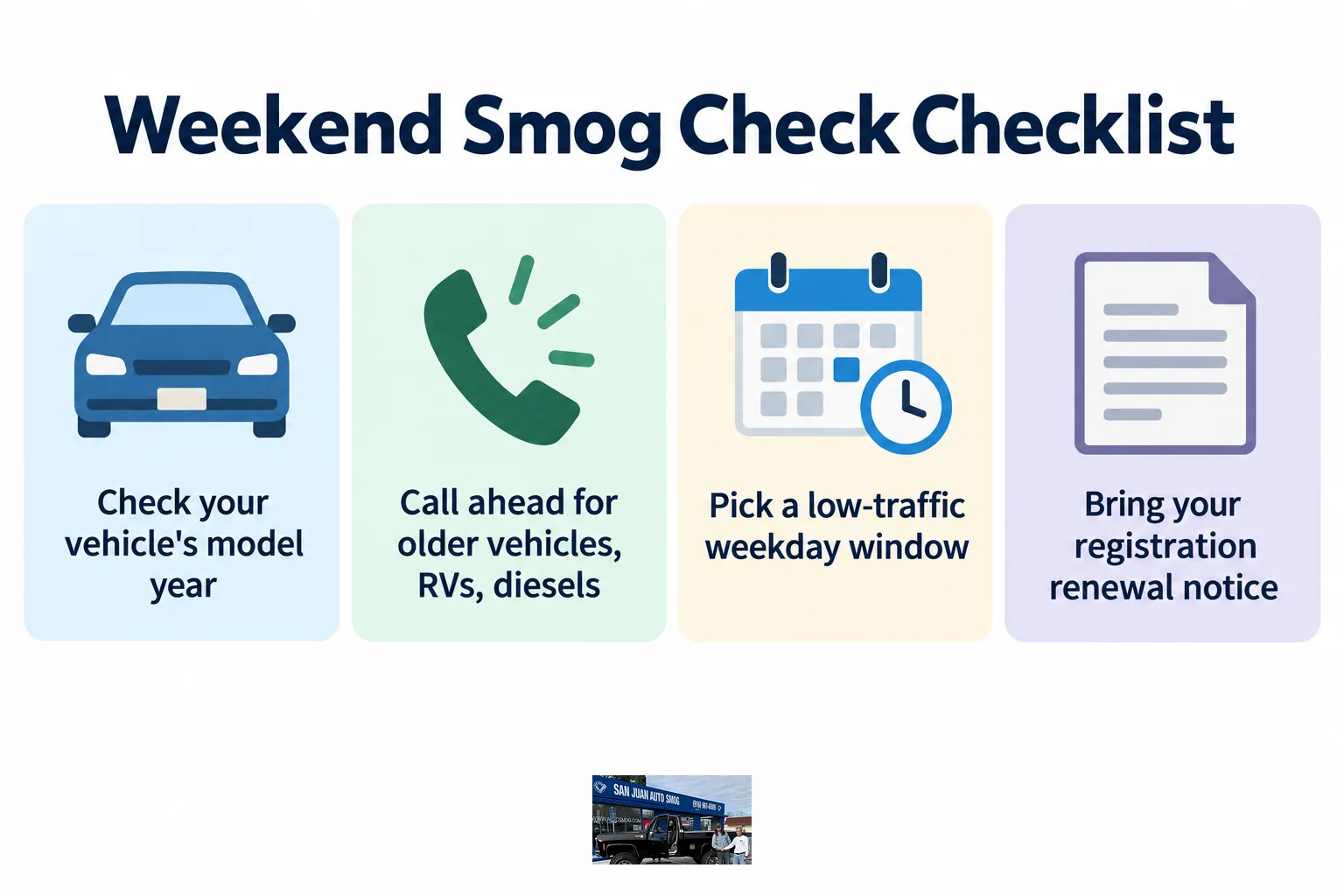
- Check your vehicle's model year. 2000 and newer typically allows a walk-in; 1999 and older usually needs an appointment.
- Call or text ahead for older vehicles, RVs, and diesels. These tests take longer and are appointment-based almost everywhere, so a same-day walk-in rarely works.
- Pick a weekday window with low traffic. Mid-morning or early afternoon on a weekday usually moves faster than a Saturday.
- Bring your registration renewal notice. Having it on hand speeds up the paperwork once testing is done.
What if your vehicle is an RV, van, or heavy truck?
These vehicles almost always require an appointment, Sunday or not, because the testing equipment and bay setup differ from a standard passenger car. Check the RV and heavy truck smog check page for what to expect before you call.
Does the day of the week affect your DMV deadline?
No — your renewal deadline is a fixed date on the calendar, and it does not shift because a particular day of the week doesn't work for you. That's the real risk with waiting for a specific Sunday opening: if that plan falls through, you're closer to a late renewal with no backup day left.
What happens if you miss the window waiting on a Sunday slot?
Registration penalties accrue the same way regardless of why the test was delayed. Testing a few days ahead of your actual deadline builds in a buffer in case a station is booked, closed, or your vehicle needs a retest.
Walk-in or appointment — which gets you done faster on a tight schedule?
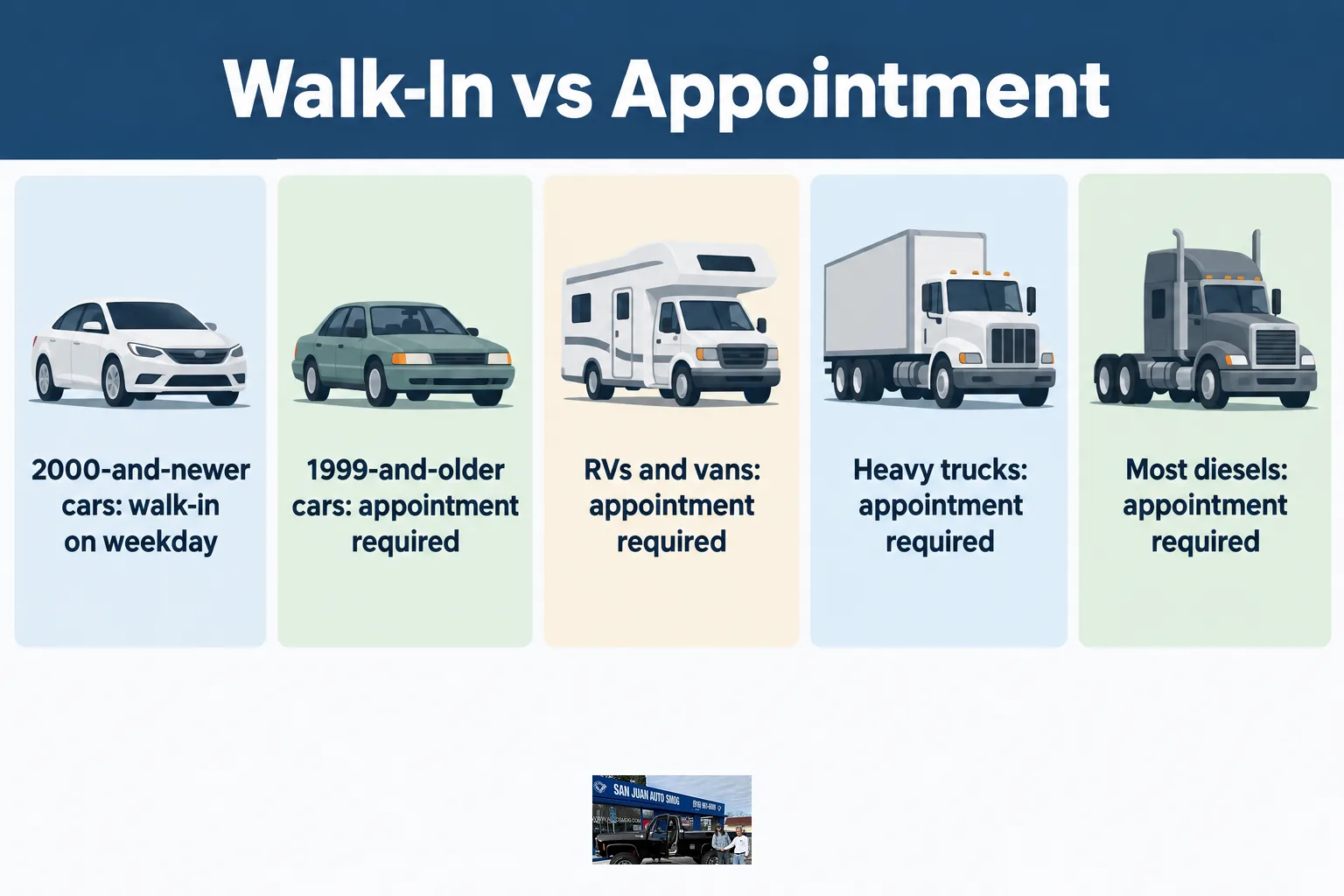
For most 2000-and-newer cars, a walk-in on a weekday beats waiting for weekend availability. Appointments matter more for vehicles that need extra time on the equipment: 1999-and-older cars, RVs, vans, heavy trucks, and most diesels.
Can you combine a smog check with an oil change to save a trip?
Yes. Booking both in one visit is common practice at full-service stations, and it means you're not scheduling two separate errands around two separate availability windows.
Check Today's Hours Before You Drive Over
San Juan Auto Smog is a STAR-certified smog check station at 4701 San Juan Ave in Fair Oaks, serving Carmichael, Sacramento, Citrus Heights, Orangevale, and Gold River. Walk-ins are welcome for 2000-and-newer vehicles, while an appointment is recommended for 1999-and-older cars, RVs, vans, heavy trucks, and oil changes. Pricing is transparent, and if you want both a smog check and an oil change done together, the combo saves $45 compared to booking them separately.
Before planning a trip around a specific day, confirm current hours and book directly through the Fair Oaks location page.
Frequently Asked Questions
Is Sunday smog testing guaranteed at any STAR station?
No. Hours are set individually by each station, so Sunday availability varies and should be confirmed directly rather than assumed from a search result.
Can I walk in for a smog check without an appointment?
For 2000-and-newer vehicles, walk-ins are generally accepted. For 1999-and-older vehicles, RVs, vans, heavy trucks, and most diesels, an appointment is recommended because those tests take longer.
What happens if my smog check fails and I need a retest?
A free retest within 60 days is standard for 2000-and-newer vehicles at many stations, though some promotions exclude it, so confirm the retest policy when you book.
Does the $45-off combo include both the smog check and oil change?
Yes, the smog and oil combo covers a full-synthetic oil change along with the smog test in one visit, and it's priced lower than booking the two services separately. Certificate and state fees are typically separate from the service price.
Will waiting for a Sunday appointment delay my DMV renewal?
It can, since your renewal deadline is a fixed date regardless of which day you test. Testing earlier in the week removes that risk entirely.
Do RVs and heavy trucks need a different kind of smog test?
Yes, many RVs, vans, and heavy trucks — including many diesel vehicles — require specialized testing equipment and longer appointment windows than a standard passenger car.
More articles
- AAA Approved Smog Check in Fair Oaks, CA
- San Juan Auto Smog in Fair Oaks: Your Local Smog Experts
- Full Synthetic Oil Change Near You in Fair Oaks
- Diesel Smog Check in Fair Oaks: What You Need to Know
- Need a Smog Check on Saturday? Fair Oaks Has You Covered
- Compare Smog Check Prices Near Fair Oaks the Smart Way