Does an Independent Oil Change Void Your Warranty?

A service warranty almost never pays for an oil change — it pays for repairs, not routine upkeep. So you cover the oil change yourself, but staying current on it is exactly what keeps the rest of your coverage intact. The real question isn't who pays for the oil. It's whether skipping the dealer for it will cost you coverage down the road, on something expensive like a transmission or engine.
That worry is what sends drivers to a quick-lube place, an independent shop, or their own driveway — and then straight to a search bar, wondering if they just blew their warranty. Short answer: almost certainly not.
Here's the federal law that protects independent maintenance, the paperwork that actually matters, and a few related money questions that tend to come up in the same breath — including the $120 oil change sticker shock and the so-called “$3,000 rule.”
Key Takeaways
- Federal law generally bars manufacturers from requiring dealer-only maintenance to keep a warranty valid, as long as the work meets the specified intervals and oil grade.
- Keep every oil change receipt showing date, mileage, and oil spec — that paperwork is your proof if a warranty claim is ever questioned.
- A full-synthetic oil change with inspection can satisfy warranty intervals just as well as a dealer visit, and common questions about intervals and receipts are covered on the oil change FAQ page.
- $120 isn't unusual for full-synthetic oil with a larger engine or added services — ask what's included before assuming you're overpaying.
- There's no official “$3,000 rule” for car repairs; it's a personal budgeting guideline, not a law or manufacturer policy.
Table of Contents
Would an oil change be covered under warranty?
Routine oil changes are almost never paid for by a factory warranty. A bumper-to-bumper or powertrain warranty covers defects and failures in parts and workmanship. It doesn't cover wear items or scheduled maintenance like oil, filters, or tire rotations. Some new vehicles come with a separate, short-term maintenance plan that covers the first few oil changes — but that's a different document from the warranty, and it usually runs out long before the warranty does.
What does the warranty actually protect, then?
It protects your right to make a claim later. If an engine fails under warranty and the manufacturer can show the oil wasn't changed on schedule, or with the wrong grade, they can deny that specific claim. The oil change was never going to be free. Doing it on time and keeping proof is what keeps the bigger repairs covered.
Does changing your own oil void your warranty?
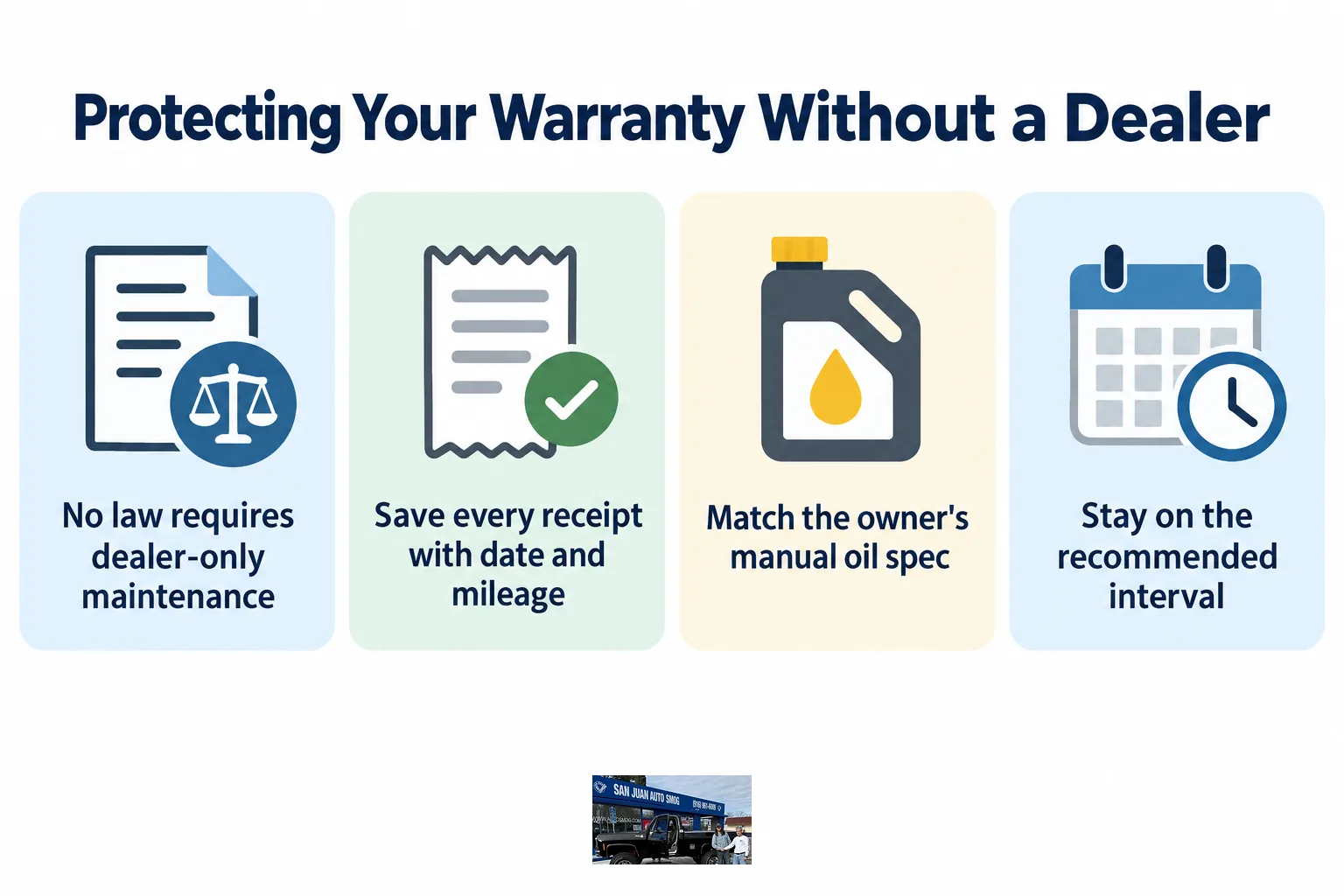
No single federal law lets a manufacturer void your entire warranty just because you changed your own oil or used an independent shop. The Magnuson-Moss Warranty Act bars manufacturers and dealers from requiring, as a blanket condition of coverage, that maintenance be done at their own shops. What they can require is that the maintenance happens, on schedule, with the right oil spec.
What do I need to prove I did it right?
Keep it simple and consistent.
- Save every receipt. Date, mileage, and the oil type used should all be on it — whether it's from a dealer, an independent shop, or oil you bought yourself.
- Match the owner's manual spec. Using the wrong viscosity or a non-synthetic oil when synthetic is called for is the kind of mismatch that can actually support a denied claim.
- Stay on the interval. A skipped or badly late oil change is easier for a manufacturer to point to than who performed it.
- Keep a simple log. A folder or spreadsheet with dates and mileage backs up the receipts if one ever gets lost.
None of this requires a dealer stamp. An independent shop or a driveway oil change, documented the same way, holds up the same way.
Is $120 normal for an oil change?
Yes — for full-synthetic oil on a larger engine or with added services, $120 is within normal range. Full-synthetic oil costs more per quart than conventional, and a V6 or V8 can need more quarts than a four-cylinder. Bundle in a filter, an inspection, or a fluid top-off, and the price climbs further.
What should move the price up or down?
Oil type, the number of quarts your engine holds, and whether the visit covers anything beyond oil and filter — a tire rotation, brake check, multi-point inspection — are the main levers. A plain synthetic oil and filter swap should land toward the lower end; a bundled package with inspection and rotation will sit higher. Before assuming you overpaid, check exactly what was included.
What is the “$3,000 rule” for car repairs?
There's no official $3,000 rule — it's an informal guideline some drivers use to decide whether a repair bill is worth paying versus replacing the car. The idea is to weigh a repair estimate against the vehicle's current value and how much life is likely left in it, not to treat any single dollar figure as a hard cutoff. A $3,000 transmission repair on a car worth $4,000 is a very different call than the same repair on a car worth $20,000.

How does this relate to oil changes?
It doesn't, directly. But neglected oil changes are one of the fastest ways to turn a routine maintenance item into exactly the kind of large repair bill that forces this decision. Sludge buildup and overheated oil feed the engine damage that tips the math toward replacement instead of repair.
Do you really need to change synthetic oil every 5,000 miles?
Not always — many full-synthetic oils are rated for longer intervals, but the number on your dashboard reminder or in your owner's manual is the one to follow. Some manufacturers specify 5,000 miles, others 7,500 or more, depending on the oil spec and engine design. Driving conditions matter too: frequent short trips, towing, or extreme heat can justify sticking closer to the shorter end even if the manual allows more.
What happens if I stretch the interval too far?
Oil breaks down and loses its ability to protect moving parts, which raises the risk of wear-related damage over time. And if a warranty claim ever comes up, an interval that's far outside what the manual specifies is easier to question than one that's on schedule.
Keep Your Oil Change on Record and on Schedule
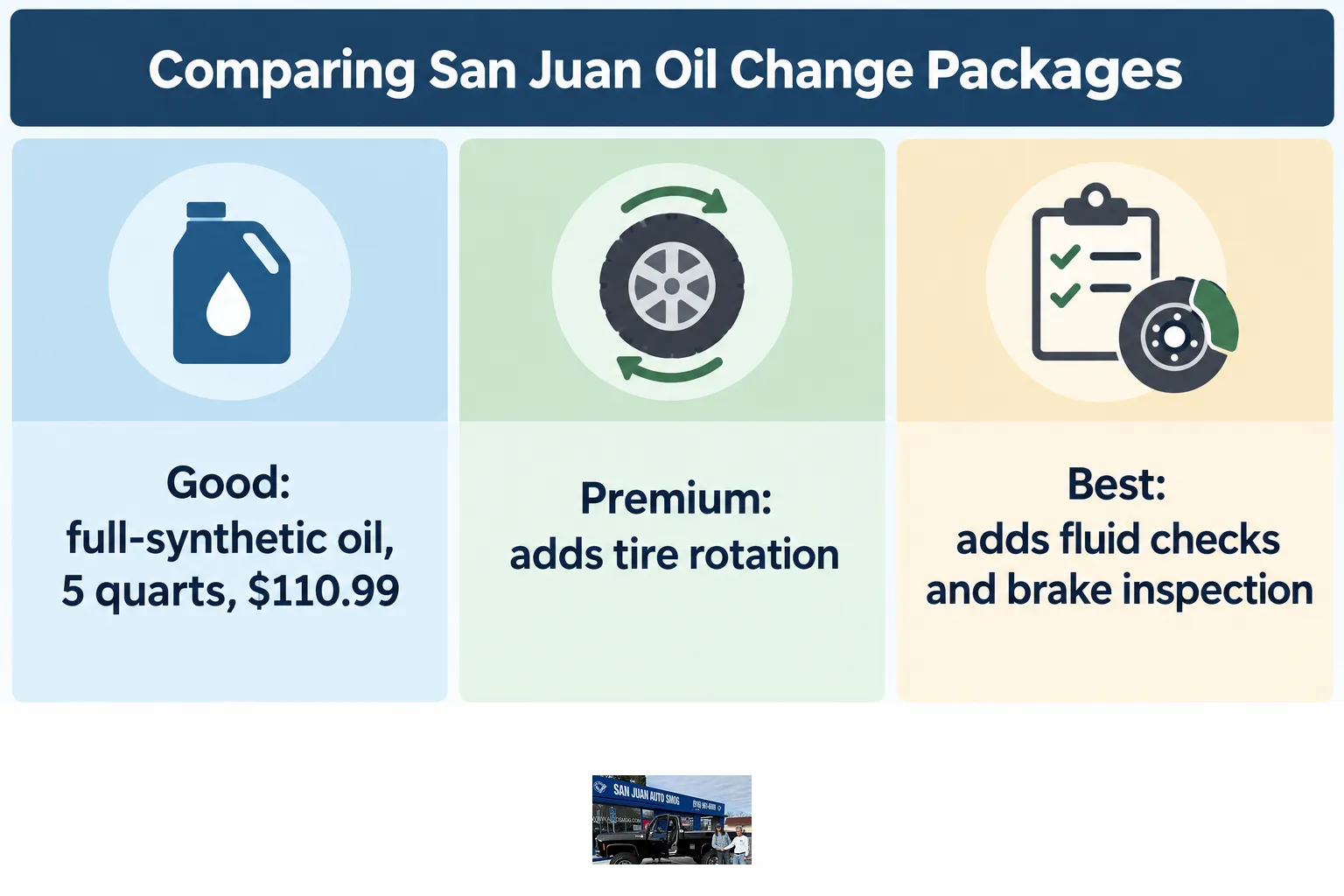
Protecting a warranty isn't about where you get an oil change — it's about doing it on time, with the right oil, and keeping the receipt. San Juan Auto Smog's full-synthetic oil change service is built around that kind of transparent pricing: the Good Package covers a full-synthetic oil change with up to 5 quarts and a standard filter for $110.99, with Premium and Best packages adding tire rotation, fluid checks, and a brake inspection for drivers who want more done in one visit.
An appointment is recommended for oil changes so the right package and oil spec are ready when the car arrives. If a smog check is also coming due, the smog + oil combo bundles both into one visit and knocks $45 off doing them separately, as detailed on the $45 off smog + oil change combo page.
Check current pricing or book your next oil change on the full synthetic oil change page before the interval comes due.
Frequently Asked Questions
Does using a quick-lube chain void my car's warranty?
No. As long as the oil used matches the manufacturer's specification and the service happens on schedule, a quick-lube or independent shop visit doesn't void the warranty. Keep the receipt showing date, mileage, and oil type.
What receipts should I keep for warranty purposes?
Keep anything that shows the date, mileage at time of service, and the oil grade or type used. A simple folder or a photo of each receipt is enough; no special dealer paperwork is required.
Does switching oil brands affect my warranty?
Switching brands doesn't matter as long as the oil meets the viscosity and specification listed in the owner's manual. What matters is the spec on the bottle, not which company made it.
What if a dealer claims my oil change wasn't done on time?
Your receipts and mileage log are your evidence. If the dates and mileage show the service happened within the manufacturer's recommended interval, that documentation settles the dispute.
Is an oil change ever included free under warranty?
Some new vehicles come with a separate maintenance plan covering the first few oil changes, but that's distinct from the warranty itself and usually expires early in ownership. Check the paperwork from the original sale to see if one applies to your vehicle.