Best Synthetic Oil for California Climate: How to Choose in 2026

Could choosing a thicker oil for California’s heat be the wrong move for your car? It’s understandable to think warm weather calls for a different viscosity, but the best synthetic oil for California climate depends on your vehicle’s requirements and how you use it. California’s conditions vary, so a statewide rule can’t replace guidance for your specific car.
This guide explains what to check in your owner’s manual, how to factor in your driving routine, and what information to have ready when arranging an oil change. Reviewing your service records can also help you see when maintenance is due and keep your vehicle’s care organized.
Key Takeaways
- The best synthetic oil for California climate depends on your vehicle’s required specifications, not simply the temperature where you drive.
- Use your owner’s manual to identify the correct viscosity grade. Viscosity describes how oil flows, not its overall quality.
- Choose between full-synthetic and high-mileage oil by considering your vehicle’s condition and the manufacturer’s maintenance guidance.
- Before an oil change, note your driving habits and maintenance schedule so the technician can match the oil and check other routine maintenance needs.
Table of Contents
What makes synthetic oil a good fit for California driving?
Synthetic engine oil is a finished lubricant formulated with base oils and additives to help lubricate and protect engine parts. It is not the same as crude oil, the unrefined petroleum commodity used to make fuels and other products. “Synthetic” describes the oil’s formulation, not a reason to choose a grade without checking your vehicle’s requirements.
California’s driving environments range from coastal areas to inland communities and higher elevations. Even around Fair Oaks and Sacramento, weather and driving routines can differ. Climate alone cannot determine the right oil; your manufacturer’s approved viscosity grade and specifications come first.
Does California heat automatically mean you need thicker oil?
No. Warm conditions don’t automatically call for thicker oil, and temperature doesn’t replace the manufacturer’s recommendation. Check your owner’s manual for approved viscosity grades and any guidance for different operating conditions. If more than one grade is approved, follow the manual’s instructions for choosing among them. Don’t select a grade just because of a hot day or a general rule about California.
Which California driving conditions can affect oil choice?
Your driving pattern can matter alongside the weather. Frequent short trips, repeated stop-and-go driving, or sustained heavy use may affect which maintenance schedule applies. Manufacturers define severe-use conditions differently, so use your manual’s description and service schedule. A commute around Fair Oaks or the Sacramento area isn’t automatically severe use. Consider how you actually drive and compare it with the manual’s guidance.
When arranging service, share your vehicle’s year, make, model, and typical use. Bring the owner’s manual or a photo of its oil requirements if available. A professional full-synthetic oil change can pair the manufacturer-required oil with your vehicle. San Juan Auto Smog offers full-synthetic oil changes, with a multi-point inspection, fluid check, and tire rotation available as options. That helps you keep maintenance organized without assuming every vehicle needs the same product.
How do viscosity grades and oil specifications guide your choice?
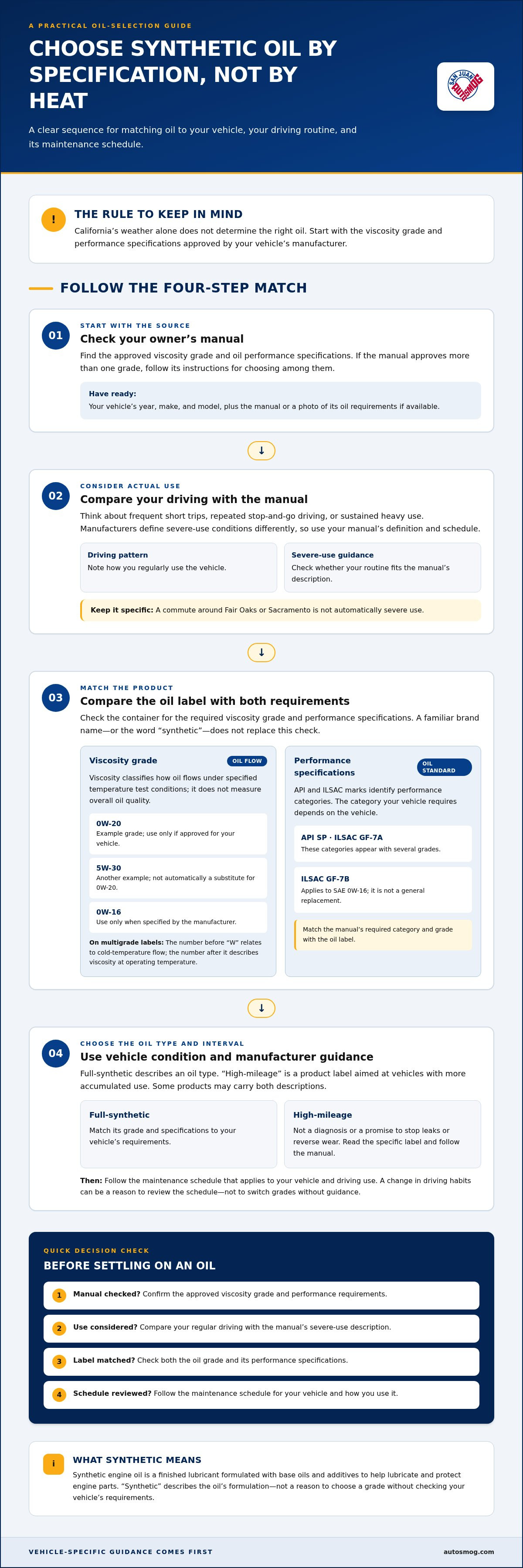
Your owner’s manual gives you two key details: the required viscosity grade and the oil performance specifications. The best synthetic oil for California climate matches both, rather than being chosen by brand name or weather alone.
What does a number such as 0W-20 or 5W-30 mean?
Viscosity grade classifies how an oil flows under specified temperature test conditions; it does not measure the oil’s overall quality. In a multigrade label, the number before “W” relates to cold-temperature flow, while the number after it describes viscosity at operating temperature. These grades are examples, not interchangeable recommendations. Use only a grade your vehicle manufacturer approves.
| Illustrative label | What to understand |
|---|---|
| SAE 0W-20 | An example of a grade that may appear in a manual; use it only if approved for your vehicle. |
| SAE 5W-30 | Another example, not automatically a substitute for 0W-20. |
| SAE 0W-16 | A lower-viscosity grade that should be used only when specified by the manufacturer. |
How can you check whether an oil meets your vehicle’s requirements?
Compare the manual’s viscosity and performance requirements with the oil container’s label. API and ILSAC marks identify performance categories, but the required category depends on your vehicle. For example, API SP and ILSAC GF-7A appear with several grades, while GF-7B applies to SAE 0W-16 and isn’t a general replacement. The API Engine Oil Standards explain API categories. A familiar brand name doesn’t replace this check. The U.S. Department of Energy’s vehicle maintenance tips also recommend using the manufacturer’s recommended grade of motor oil.
For another practical overview, see Professional Full Synthetic Oil Change in Fair Oaks: The Ultimate Engine Protection Guide. San Juan Auto Smog’s full-synthetic oil change service helps you keep routine maintenance on schedule.
Which synthetic oil type fits your vehicle and driving habits?
Full-synthetic and high-mileage oils aren’t competing answers for every car. Full-synthetic describes an oil type; high-mileage is a product label aimed at vehicles with more accumulated use. Some products may carry both descriptions. The best synthetic oil for California climate still depends on your vehicle’s required specifications, its condition, and the manufacturer’s maintenance guidance.
Is high-mileage synthetic oil right for an older car?
Not automatically. “High-mileage” is a product description, not a diagnosis or a promise to stop leaks or reverse wear. Formulations vary, so read the specific label and compare its viscosity and performance claims with your owner’s manual. A vehicle’s age or odometer reading alone doesn’t determine which oil it needs. Follow the manufacturer’s guidance first.
When should driving habits matter more than the climate label?
Repeated short trips or use that the manufacturer identifies as severe service may affect your maintenance schedule. Check the manual’s definition and instructions rather than applying a generic interval. A change in driving habits can be a reason to review the schedule, not to switch oil grades without guidance. The related guide, Professional Full Synthetic Oil Change in Fair Oaks: The Ultimate Engine Protection Guide, offers more context on routine synthetic-oil care.
Use this simple sequence before choosing:
- Check the owner’s manual for oil requirements.
- Note whether your regular driving matches the manual’s severe-use description.
- Compare the oil label with the required grade and specifications.
- Follow the maintenance schedule that applies to your vehicle and use.
For help matching your vehicle’s requirements during routine maintenance, schedule a full-synthetic oil change.
How can Fair Oaks drivers choose and maintain the right synthetic oil?
A simple routine makes oil selection practical: start with your vehicle’s instructions, then account for how you drive. The best synthetic oil for California climate isn’t selected by weather alone. Keep the manual or a photo of its oil requirements handy when scheduling service.
- Check the manual. Find the approved viscosity grade and oil performance specifications.
- Note your driving. Mention frequent short trips, heavy use, or other patterns the manual identifies as severe service.
- Match the label. Compare the oil container’s grade and specifications with the manual.
- Follow the schedule. Use the maintenance interval that applies to your vehicle and driving conditions.
During an oil change, a technician can use the vehicle information you provide to select oil that matches its requirements and check fluid levels. Those checks can help identify maintenance items to discuss, without assuming that unrelated repairs are needed or completed.
What routine checks make sense during an oil-change visit?
Depending on your vehicle’s needs and maintenance schedule, you can also consider optional add-ons such as fluid checks, a tire rotation, a brake check, air or cabin filter replacement, and checking or replacing windshield wipers if needed. A multi-point inspection can help identify items that may need attention. These services support general upkeep; they don’t guarantee a smog-test result.
Can an oil change be coordinated with a smog check?
If both services are due, scheduling them together can save a separate visit. An oil change alone does not help a vehicle pass a California smog inspection. Proper routine maintenance supports vehicle care, but a smog check evaluates emissions requirements separately.
San Juan Auto Smog serves drivers in Fair Oaks, Carmichael, Sacramento, Citrus Heights, Orangevale, and Gold River. If your oil change is due, you can schedule a full-synthetic oil change and discuss the routine checks that fit your vehicle.
Make your next oil change easier to plan
Keep a note of your vehicle’s required oil grade and specifications with its service records. Add the date and mileage after each visit, then bring that information next time. A clear maintenance history is especially useful if you drive an older vehicle or share maintenance decisions with a family member.
The best synthetic oil for California climate is the oil that fits your vehicle’s requirements and the way you use it. You don’t need to guess based on a warm day or choose a product simply because its label sounds suited to an older car. A knowledgeable technician can help make oil selection and routine maintenance straightforward.
San Juan Auto Smog offers full-synthetic oil changes, with a multi-point inspection, fluid check, and tire rotation available as options. Drivers in Fair Oaks and nearby Sacramento communities can schedule a full-synthetic oil change to keep maintenance on track.
Frequently Asked Questions
Does California’s hot weather mean I should use thicker synthetic oil?
No. California weather alone doesn’t determine whether thicker oil is appropriate. Start with the viscosity and performance requirements your vehicle manufacturer approves, then check the owner’s manual for guidance about different operating conditions. The best synthetic oil for California climate is vehicle-specific. Don’t switch grades just because the weather is warm; an unapproved grade may not match the engine’s design.
Is full-synthetic oil better for every car in California?
Not automatically. The correct oil must meet your vehicle’s required viscosity and performance specifications, whether the manual calls for full synthetic or allows another formulation. Two cars driven on the same commute may have different oil requirements. Compare the container’s label with the manual before choosing. If your manual specifies a particular performance standard, a familiar brand name alone isn’t enough.
Can I switch from conventional oil to synthetic oil in an older vehicle?
Often, the decision depends on the owner’s manual and the engine’s condition, not age alone. Switching doesn’t automatically cause leaks or repair existing wear. Before changing oil type, confirm that the product meets the vehicle’s specified grade and performance requirements. For an older or high-mileage vehicle, maintenance records and a routine inspection can help you track its needs without assuming a particular oil will prevent problems.
How often should I change synthetic oil in California?
There’s no single interval for every vehicle. Follow the manufacturer’s maintenance schedule, including any oil-life monitoring instructions if your vehicle has that feature. Check whether your regular use fits the manual’s normal or severe-service guidance. Don’t extend the interval just because the oil is synthetic. If you’re unsure which schedule applies, note your typical trips and driving conditions before reviewing the manual or arranging maintenance.
Does changing synthetic oil help a car pass a California smog check?
No. An oil change alone doesn’t make a vehicle pass a smog inspection. Regular maintenance supports engine performance, reliability, and the long-term health of emissions equipment, but the inspection assesses applicable emissions requirements. Drivers in Fair Oaks, Carmichael, Sacramento, Citrus Heights, Orangevale, and Gold River can keep routine maintenance on schedule and arrange a smog check when due, without assuming either guarantees a passing result.
More articles
- Pre-Purchase Inspection in Fair Oaks: Buy with Confidence
- Smog and Oil Change Combo Deals in Fair Oaks
- Change of Ownership Smog Check: California Requirements
- Looking for a Low Cost Smog Check Near You?
- How Long Do Smogs Take? | Gold River
- Smog Check for Heavy Vehicles: California Requirements and Local Testing