Why California Smog Checks Fail and How Batteries Affect Results

A new battery can affect a California smog check even when your vehicle seems to run normally. Disconnecting or replacing it may reset readiness monitors, while an active check-engine light generally means the vehicle will fail. Common reasons for smog check failure in California also include emissions readings above state limits, faulty sensors, vacuum leaks, and non-approved modifications.
A smog test checks more than what comes out of the tailpipe. Depending on the vehicle, the inspection may also check its onboard diagnostic system and whether required self-tests are complete. After a battery replacement, California’s Bureau of Automotive Repair advises driving the vehicle for a week or two so the readiness monitors can reset before the Smog Check.
This article explains what a California smog check measures, how a battery reset can affect the result, and what common failures may indicate. You’ll also learn why the inspection report matters and how routine maintenance can support engine performance and emissions-system health.
Key Takeaways
- After a battery replacement, readiness monitors may need time and suitable driving conditions to complete before testing.
- A check engine light or diagnostic trouble code can point to an emissions problem, but the code alone doesn’t identify every needed repair.
- Leaks, worn sensors, excessive emissions, and non-approved modifications are among the issues that can lead to a failed inspection.
- Your Vehicle Inspection Report explains the test result and helps guide the next step; routine maintenance can also support long-term engine and emissions-system health.
Table of Contents
Why can a recent battery replacement affect the results?
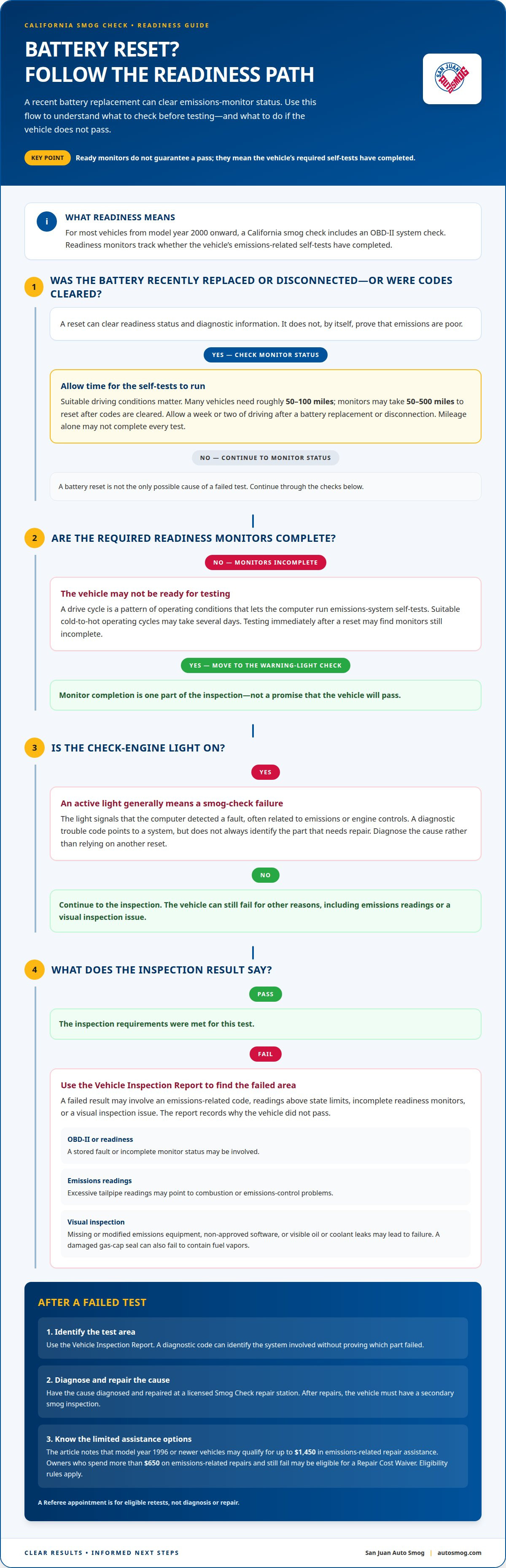
Replacing or disconnecting a battery can reset a vehicle’s onboard diagnostic system and clear its readiness status. That reset doesn’t prove emissions are poor, but it can leave required self-tests incomplete when the vehicle is tested.
For most vehicles from model year 2000 onward, a California smog check includes an OBD-II system check. The vehicle’s computer must report readiness for its monitors, which track whether emissions-related systems have completed their self-tests.
Drive Cycles and Monitor Completion
A drive cycle is a pattern of operating conditions that lets the vehicle’s computer run its emissions-system self-tests. After a battery reset, the monitors may need suitable cold-to-hot operating cycles before they show ready. The exact conditions vary by make and model, so there’s no single mileage that completes every monitor.
Driving conditions and routes vary, so mileage alone may not complete every test. Allow a week or two of driving after a battery replacement or disconnection before testing. A drive cycle can take several days, so returning for a test immediately may mean the monitors are still incomplete. An emissions readiness monitor check can show which monitors are still incomplete before you test. Use the inspection report to understand the result.
Check Engine Lights and Emissions Readings
The check-engine light signals that the vehicle’s computer has detected a fault, often related to emissions or engine controls. BAR states that a vehicle will not pass a Smog Check with the check engine light on, even if it seems to run normally. Check engine light diagnosis can help find the cause before testing. The warning light and emissions readings are related, but they reflect different parts of the inspection.
A battery reset can temporarily turn off the light while also clearing diagnostic information and readiness status. If an emissions-related fault returns, the light may come back and the vehicle can fail testing. A diagnostic trouble code helps identify the system involved, while the inspection report records why the vehicle did not pass. Address the cause rather than relying on a reset before testing again.
Why did my vehicle fail the smog inspection?
A failed California smog inspection means at least one part of the test did not meet its requirements. The Vehicle Inspection Report identifies the reason, such as an emissions-related diagnostic trouble code, excessive readings, or a visual inspection issue. For most vehicles from model year 2000 onward, the inspection includes an OBD-II system check.
An active check-engine light linked to an emissions fault can cause a failure. The diagnostic trouble code identifies a system in which the computer detected a problem, but it doesn’t always identify the failed part. For example, an oxygen-sensor code calls for diagnosis of the sensor circuit and related conditions before choosing a repair. Replacing a part based on the code alone may leave the underlying cause unresolved.
Some failures involve the vehicle’s physical condition rather than a stored code. Problems with emissions equipment or visible leaks may affect the inspection result. Tailpipe or OBD-II readings above state limits can also result in a failed test.
Use the Vehicle Inspection Report to identify which test area failed, then have the cause diagnosed and repaired at a licensed Smog Check repair station. San Juan Auto Smog is a STAR-certified Test & Repair station (License # RC 303707) at 4701 San Juan Ave, Fair Oaks, CA 95628, so it can test the vehicle, provide smog failure diagnosis and emissions-related repairs, and retest it. After repairs, the vehicle must undergo a secondary smog inspection. If the check-engine light returns after repair, the diagnostic issue may remain unresolved. A Referee appointment is for eligible retests, not diagnosis or repair.
Through its Consumer Assistance Program, California’s Bureau of Automotive Repair says model year 1996 or newer vehicles may qualify for up to $1,450 for emissions-related repairs if the owner meets the program’s income and other eligibility requirements; repairs are done at STAR test-and-repair stations after approval. BAR’s Smog Check Reference Guide also explains that an owner who spends at least $650 on repairs at a Smog Check station and still fails a biennial inspection may qualify for a one-time Repair Cost Waiver, issued only by a Referee.
A California smog retest’s price depends on the station and the vehicle. After repairs, a smog check provides the secondary inspection needed to determine whether the vehicle now passes.
Common reasons for California Smog Check failures
A California Smog Check can fail in several distinct areas: emissions readings, onboard diagnostics, or visual inspection. Excessive tailpipe emissions may point to combustion or emissions-control problems, while an OBD-II failure may involve a stored fault or incomplete readiness monitors. A disconnected battery can reset monitor status, but it is only one possible reason for an unsuccessful test.
Faulty sensors and computer controls can disrupt how the engine manages emissions. For example, an oxygen sensor that reports inaccurate information may affect the air-fuel mixture and raise emissions readings. Vacuum leaks can also disrupt engine operation. A cracked hose or leak in the evaporative emissions system may need diagnosis; a smoke test can help locate an EVAP leak beyond a loose or damaged gas cap.
The visual inspection checks whether emissions equipment is present and appears properly configured. Missing or modified equipment, non-approved software, or visible oil or coolant leaks in the engine bay can lead to failure. A gas cap with a cracked rubber seal may not contain fuel vapors, so tighten it until it clicks and replace it if damaged. In California, an emissions modification is not acceptable just because the vehicle runs smoothly.
Vehicle age and accumulated wear can make several symptoms appear together. High-mileage vehicles may show wear across emissions components, such as oxygen sensors, ignition parts, or the catalytic converter. A failed converter may need replacement, but diagnosing why it failed can help prevent the same underlying problem from damaging its replacement.
Use the inspection report to identify the failed test area, then address the cause before testing again. When your DMV renewal notice says a Smog Certification is required, the registration can’t be renewed until the vehicle passes. The report distinguishes a monitor issue from excessive emissions or a visual defect, helping guide the next diagnostic step.
What are the most common reasons a car fails a California smog check?
Most failures involve emissions readings, onboard diagnostics, or visible equipment. Common reasons for smog check failure in California include faults affecting combustion, emissions controls, or required equipment. A failed test identifies a result, not necessarily its exact cause. For example, an oxygen-sensor code may point to a problem, but diagnosis should consider its wiring and related engine conditions before parts are replaced.
Excessive emissions can result from incomplete combustion or ineffective emissions controls. Worn spark plugs or ignition wires can interfere with combustion, while a faulty sensor may affect how the engine manages its air-fuel mixture. A catalytic converter that can’t reduce emissions effectively may also contribute. Finding out why a component failed helps prevent replacing a part while the original cause remains.
Leaks can affect vehicle operation or allow fuel vapors to escape. A vacuum leak may disrupt engine performance, while an EVAP leak may come from a damaged hose or gas cap. A smoke test can help locate a leak that isn’t obvious during a visual check. The leak’s location guides the repair.
Visible problems can cause a failure even without a warning light. Missing or modified emissions equipment, non-approved software, and visible oil or coolant leaks in the engine bay may be identified during inspection. A disconnected battery can leave readiness monitors incomplete, which is different from confirming that an emissions part has failed.
Knowing the common reasons for smog check failure in California can help you use the inspection report as a starting point for diagnosis. Match the failed area to the next step: emissions readings, diagnostic information, readiness status, or visible condition. If your vehicle also needs routine maintenance, an optional multi-point inspection can help identify other concerns. An oil change supports engine performance and long-term emissions-system health, but it won’t make a vehicle pass a smog check.
San Juan Auto Smog
San Juan Auto Smog helps California drivers understand inspection results and complete the appropriate smog check. Drivers in Fair Oaks, Carmichael, Sacramento, Citrus Heights, Orangevale, and Gold River can choose a STAR-Certified Smog Check, an Older Vehicle Smog Check for vehicles 1999 and older, or an RV and motorhome smog check. As a STAR-certified Test & Repair station (License # RC 303707), San Juan Auto Smog can also diagnose and repair a vehicle that fails and then retest it.
If routine service is due, schedule a full-synthetic oil change alongside a smog check to save a separate trip. San Juan Auto Smog offers full-synthetic oil changes, with a multi-point inspection, fluid check, and tire rotation available as options. An oil change supports regular vehicle maintenance, but it won’t make a vehicle pass a smog inspection.
If you’re ready to arrange an inspection or discuss your next step, contact San Juan Auto Smog. Text (916) 961-6009 to make an appointment.
Make Your Next Smog Check Part of a Care Plan
A smog inspection is also a useful time to consider your vehicle’s ongoing care. Keep the inspection report with your maintenance records, and use it alongside your owner’s manual when planning your next service. Understanding the common reasons for smog check failure in California helps you treat the result as useful information, not a reason to replace parts without diagnosis.
San Juan Auto Smog offers STAR-Certified Smog Checks and Older Vehicle Smog Checks for vehicles 1999 and older. If routine service is due, a Full-Synthetic Oil Change can be another practical item to plan. An oil change doesn’t make a vehicle pass, but regular maintenance supports engine performance and long-term emissions-system health.
Choose a next step that fits your vehicle’s needs, whether that means arranging a smog inspection or planning routine maintenance. Contact San Juan Auto Smog today, and take the next step toward informed, consistent vehicle care. Please book ahead. Text (916) 961-6009 to make an appointment.
Frequently Asked Questions
What About Gross Polluters?
According to BAR’s STAR Program FAQ, only STAR stations may inspect gross-polluting vehicles; BAR’s guide adds that a Referee may also certify them when applicable. The vehicle still needs a passing Smog Check before registration. San Juan Auto Smog is a STAR-certified Test & Repair station (License # RC 303707) and handles gross polluter smog checks. The designation affects where the vehicle can be certified, but it doesn’t identify which part needs attention. Use the Vehicle Inspection Report to see the failed areas, then have the cause diagnosed and repaired before the required retest.
Will an illuminated check engine light cause a failed inspection?
Yes. According to BAR, a vehicle will not pass a Smog Check with the check engine light on, even if the vehicle seems to drive normally. The light means the vehicle’s computer has detected a fault, but it doesn’t tell you which repair will fix it. Don’t treat a dark dashboard after a battery reset as proof the issue is resolved; the fault may return.
How do check engine light and diagnostic trouble codes cause a California smog test failure?
An emissions-related diagnostic trouble code can trigger the check-engine light and cause the vehicle to fail. A code identifies the system or condition the computer detected, not necessarily the exact part to replace. For example, a sensor-related code may involve its wiring or connection. Reviewing the code alongside symptoms and inspection findings helps narrow down the next diagnostic step.
More articles
- Emergency brake check in Gold River: How it operates
- San Juan Auto Smog vs Autocheckcenter: A Fair Comparison
- Smog Check in Carmichael Without the Pressure Sales
- What to Do If You Miss an Oil Change to Limit Engine Wear
- STAR Smog Check for a 2001 Van Near Citrus Heights
- Benefits of High Mileage Synthetic Oil in Orangevale for Older Engines