Benefits of High Mileage Synthetic Oil in Orangevale for Older Engines

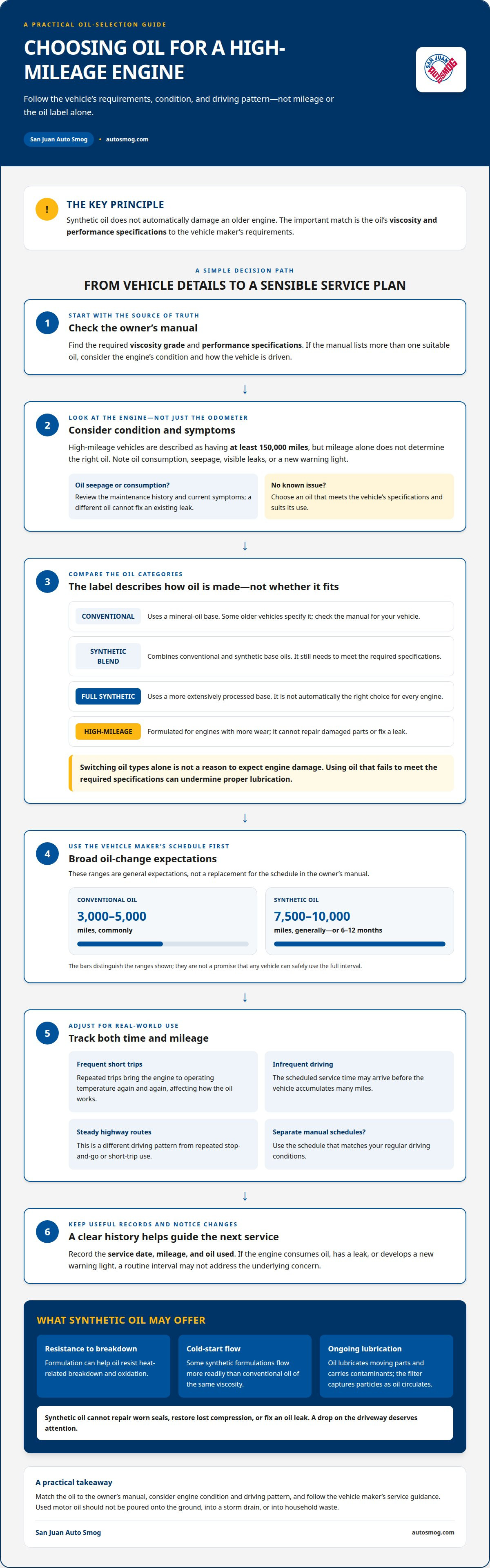
Synthetic oil doesn’t automatically damage a high-mileage engine. The benefits of high mileage synthetic oil in Orangevale can include dependable lubrication and resistance to oil breakdown, provided the oil meets the vehicle’s required viscosity and specifications. The right choice depends on the engine and its condition, not mileage alone.
It’s understandable to be cautious about changing oil types in an older vehicle, especially if it has always used conventional oil. Switching oil types alone isn’t a reason to expect engine damage, but the owner’s manual and the vehicle’s needs should guide the decision.
This article compares conventional oil, synthetic blends, and full synthetic oil, explains what high-mileage formulas are designed for, and outlines signs to consider when choosing oil. You’ll also learn why synthetic oil intervals vary and how to account for mileage and time without relying on a one-size-fits-all schedule.
Key Takeaways
- Learn what synthetic oil may offer older engines, including how it handles heat and oil breakdown.
- See how conventional oil, synthetic blends, and full synthetic differ, and why a vehicle’s original design matters.
- Understand why oil-change timing depends on more than the type of oil, including how you drive and the vehicle maker’s guidance.
- Find out what to consider when choosing oil for a high-mileage engine and which routine checks can support ongoing maintenance.
Table of Contents
What are the advantages to synthetics?
Synthetic oil uses refined, engineered base oils and additives to protect moving engine parts. Its formulation can resist heat-related breakdown and oxidation, helping the oil maintain its protective qualities during demanding operation. Repeated stop-and-go trips around Orangevale, for example, bring an engine to operating temperature again and again. Oil also encounters heat on longer drives, so resistance to breakdown matters across different driving patterns.
Some synthetic formulations flow more readily during cold starts than conventional oils of the same viscosity grade. That can help oil circulate as the engine starts, when moving parts need lubrication. The exact protection depends on using oil that meets the vehicle maker’s viscosity and performance requirements. A synthetic label alone doesn’t make an oil suitable for every engine.
Oil carries contaminants and helps protect engine surfaces from wear. Heat and use can change its condition over time, while the filter captures particles as oil circulates. Synthetic oil’s resistance to breakdown can help it retain useful properties during service, but it cannot repair worn seals, restore lost compression, or fix an oil leak. A drop on the driveway still deserves attention.
Professional oil changes also provide a responsible way to handle used oil. A shop collects drained oil separately, stores it for handling, and sends it for recycling or proper management. Don’t pour used motor oil onto the ground, into a storm drain, or into household waste. The U.S. EPA notes that used oil can pollute the environment if it isn’t recycled or disposed of properly, and that drained oil filters can be recycled too.
For an older engine, the practical advantage is choosing an oil that meets the manufacturer’s specifications and suits the vehicle’s condition and use. During service, a technician can also note visible leaks or other maintenance concerns. Synthetic oil may support consistent lubrication, but the right oil and change schedule still depend on the engine, its operating conditions, and the owner’s manual.
Conventional oil versus synthetic blends and full synthetic oil
Conventional oil uses a mineral-oil base, while full synthetic oil uses a more extensively processed base. A synthetic blend combines conventional and synthetic base oils. These categories describe how oils are made, not which one suits your engine. For example, two bottles labeled “full synthetic” can still have different viscosities and performance specifications. The vehicle maker’s requirements matter more than the label alone.
Some vehicles from the 1990s and earlier may specify conventional motor oil, while others may call for a different type. Check the owner’s manual or manufacturer guidance for your specific vehicle. Look for the specified viscosity and performance requirements, then choose an oil that meets them. If the manual lists more than one suitable oil, driving conditions and engine condition can help guide the selection.
An older vehicle that calls for a particular oil grade shouldn’t receive a different grade simply because synthetic sounds more advanced. A blend may be suitable if it meets the same requirements, as can full synthetic. Switching oil types alone doesn’t inherently harm an engine, but using oil that fails to meet the required specifications can undermine proper lubrication.
In Orangevale, a practical comparison starts with the vehicle’s year, engine, manual, and current symptoms, not mileage alone. A technician can use those details to select an appropriate oil and note concerns such as visible leakage during service. If the manual supports full synthetic, a professional oil change can pair the correct product with the vehicle’s requirements. If the engine has a known issue, choosing a different oil type isn’t a substitute for diagnosing it.
Oil-change intervals
Oil-change timing depends on the vehicle maker’s schedule, oil type, engine condition, and driving pattern. Many vehicles list a mileage interval and a time interval, and some use an oil-life monitor. Your owner’s manual is the guide; FuelEconomy.gov also recommends using the manufacturer’s recommended grade of motor oil, which can improve gas mileage by 1%–2%.
Track both mileage and elapsed time when planning service. A vehicle driven infrequently, for example, may reach its scheduled service time before accumulating many miles. A car used for repeated short trips also operates differently from one driven mainly on steady highway routes. These patterns affect how hard the oil works, so don’t set an interval based only on the word “synthetic” on the container.
The correct timing depends on the vehicle’s instructions and how it’s driven. If your manual gives separate schedules for different driving conditions, use the one that matches your regular use.
Keep a clear record of the service date, mileage, and oil used. This helps a technician understand the engine’s maintenance history, especially if you’ve recently bought an older vehicle or don’t know when its last oil change occurred. If the engine consumes oil, has a leak, or develops a new warning light, following the usual interval may not address the underlying concern. During maintenance, a technician can assess the symptoms and explain whether they need attention before the next scheduled change.
Synthetic oil and high-mileage engines
High mileage alone doesn’t determine the right oil. Engine condition, manufacturer specifications, and the oil’s intended formulation all matter.
High-Mileage Oil and Engine Conditions
High-mileage oils are marketed for engines with significant mileage, but condition matters alongside the odometer. An older engine with seepage or oil consumption may prompt a closer look at its maintenance history and current symptoms. High-mileage oil is formulated for engines with more wear, but it cannot repair damaged parts or fix an existing leak. A technician can assess those concerns during service.
High-Mileage Synthetic and Full Synthetic Oil
“High-mileage” describes an oil’s intended use, while “full synthetic” describes its oil base. A product can be both: full synthetic formulated for higher-mileage engines. High-mileage formulas may include additives intended to support aging seals, but they don’t restore worn seals or correct oil loss. The label alone doesn’t establish suitability; the oil must also meet the engine’s required viscosity and specifications.
Automaker Recommendations and Warranty Effects
Automakers specify oil requirements in the owner’s manual; they don’t all recommend the same high-mileage formula. Follow the stated viscosity and performance specifications, and keep service records showing the oil used and change dates. Warranty terms describe maintenance documentation requirements. Using oil that fails the vehicle’s stated requirements can create a maintenance concern, so a high-mileage label isn’t a substitute for checking compatibility.
Viscosity and Specifications
Viscosity is the oil’s resistance to flowing, shown by a grade such as the one listed in the owner’s manual. The manual also identifies performance specifications the oil must meet. Choose both requirements together, even on a high-mileage engine. The American Petroleum Institute’s engine oil program explains the service symbols found on oil bottles. For example, don’t switch to a thicker grade just because an older engine uses oil. If you’d like a broader check, add an optional multi-point inspection to review related maintenance concerns.
San Juan Auto Smog: Full-Synthetic Oil Change
San Juan Auto Smog provides a Full-Synthetic Oil Change when full synthetic suits your vehicle’s requirements and condition. San Juan Auto Smog offers full-synthetic oil changes, with a multi-point inspection, fluid check, and tire rotation available as options. Bring your maintenance history and any notes about oil use or leaks. These details help technicians understand the engine’s needs and align the service with its specifications.
Routine maintenance is also a good time to discuss related concerns, such as fluid condition or brake symptoms. An oil change supports regular engine maintenance, but it doesn’t repair a leak or guarantee a smog result. As a STAR-certified Test & Repair station (License # RC 303707) at 4701 San Juan Ave, Fair Oaks, CA 95628, San Juan Auto Smog performs STAR-certified smog checks and can diagnose a vehicle that fails, handle emissions-related repairs, and retest it. The BAR Smog Check Program explains how inspections work. A smog check and an oil change serve different purposes, even when scheduled together. You can also ask whether your vehicle needs a tire rotation, air-filter check, or new windshield wipers.
If you’re ready to discuss an oil change for your older vehicle, contact San Juan Auto Smog.
Choose the Next Maintenance Step with Confidence
For Orangevale drivers, the benefits of high-mileage synthetic oil are greatest when the oil suits the vehicle’s needs and maintenance history. Keep your next service focused on your car’s care rather than choosing a product by its label alone.
Regular maintenance is easier to manage when you plan service around your vehicle’s schedule. If an oil change is due, take the next step at a time that works for you.
Schedule a Full-Synthetic Oil Change with San Juan Auto Smog and keep your vehicle’s maintenance moving forward. Please book ahead. Text (916) 961-6009 to make an appointment.
Frequently Asked Questions
Can synthetic oils damage my high-mileage vehicle?
Synthetic oil won’t damage an engine simply because the vehicle has high mileage. The key is matching the oil to the engine’s required viscosity and performance specifications. If you recently bought an older vehicle, its maintenance records can help clarify what oil it has used. If records are incomplete, a technician can review the vehicle’s requirements and note visible concerns during routine service.
How long can I go between oil changes?
Follow the schedule in your owner’s manual, including any schedule that reflects your driving conditions. Use the manual’s mileage and time limits, or the oil-life monitor if your vehicle has one. Frequent short trips or long periods of idling can affect how closely your driving matches the manual’s conditions.
What are the benefits of high-mileage synthetic oil for cars with over 75,000 miles?
A high-mileage formulation may suit a car with over 75,000 miles if it meets the engine’s requirements. That mileage alone doesn’t mean the vehicle needs a particular oil. Consider its service history and symptoms, such as oil use or seepage, alongside the owner’s manual. For example, an older car with no known oil concerns may have different needs from one with a documented history of oil loss.
Does high-mileage synthetic oil reduce leaks, oil consumption, or engine wear?
High-mileage synthetic oil may be formulated with aging engines in mind, but it doesn’t repair damaged seals or guarantee lower oil consumption. If you notice a fresh spot where the car is parked, note when it appears and mention it during service. A technician can inspect for visible signs and help distinguish routine oil use from a leak that needs further diagnosis.
How often should high-mileage synthetic oil be changed?
Follow the vehicle maker’s service schedule rather than extending the interval based only on an oil’s label. The manual’s recommendations, time between services, driving pattern, and engine condition all inform the schedule. Keep the service date and odometer reading together, especially if you share the vehicle or recently changed owners. If the oil level drops between appointments, mention the pattern at your next visit.
Which Orangevale shops offer high-mileage synthetic oil changes and what do they include?
San Juan Auto Smog offers a Full-Synthetic Oil Change for drivers in Orangevale, Fair Oaks, Carmichael, Sacramento, Citrus Heights, and Gold River. The oil and filter are ready before you arrive, and each oil change includes gloves, protective seat covers, and disposable floor mats. San Juan Auto Smog offers full-synthetic oil changes, with a multi-point inspection, fluid check, and tire rotation available as options. Text (916) 961-6009 to make an appointment.
More articles
- Smog Check in Carmichael Without the Pressure Sales
- STAR Smog Check for a 2001 Van Near Citrus Heights
- What Kind of Oil Does My Car Need? Check Your Manual
- Who Does STAR Certified Smog Checks Near Carmichael?
- What paperwork do I need for a smog check, and how long will it take?
- How Long Does a Smog Check Take at the Inspection Station?