How to Make My Car Last Longer in Citrus Heights

Yes, an older car can keep serving you when its maintenance suits its condition and driving needs. If you’re wondering how to make your car last longer in Citrus Heights, focus on consistent care, accurate service records, and prompt attention to changes in how it runs. A useful routine doesn’t need to be complicated, but it should fit your vehicle.
Keeping an older vehicle can mean balancing routine upkeep with unexpected concerns. A clear maintenance history shows what’s been done and what may need attention next. This guide covers practical care for your car’s fluids, engine, finish, and tires, as well as signs that an unusual sound, smell, or change in handling deserves a closer look.
You’ll also learn to make maintenance decisions without relying on a one-size-fits-all schedule. Your owner’s manual, the vehicle’s condition, and any symptoms you notice all help determine the next step. Use this guidance to build a sensible plan for driving around Citrus Heights and nearby communities.
Key Takeaways
- Learn which fluid levels to monitor and what leaks or changes in fluid appearance may signal.
- Understand how to select oil for an older engine and spot belts or hoses that may need attention.
- Use simple washing and waxing habits to help protect your car’s finish from rust.
- Find out how tire pressure, rotation, and wear checks can support more even tire life.
Table of Contents
1. Checking fluid levels and watching for leaks
Your owner’s manual provides the maintenance schedule for your specific make, model, engine, and driving conditions. Use it to plan fluid checks and changes, since intervals vary by vehicle. If you don’t have the manual, find maintenance information for your exact vehicle. Record service dates, mileage, and completed work. For Citrus Heights drivers asking how to make their car last longer, tracking maintenance against the manufacturer’s schedule is a practical first step.
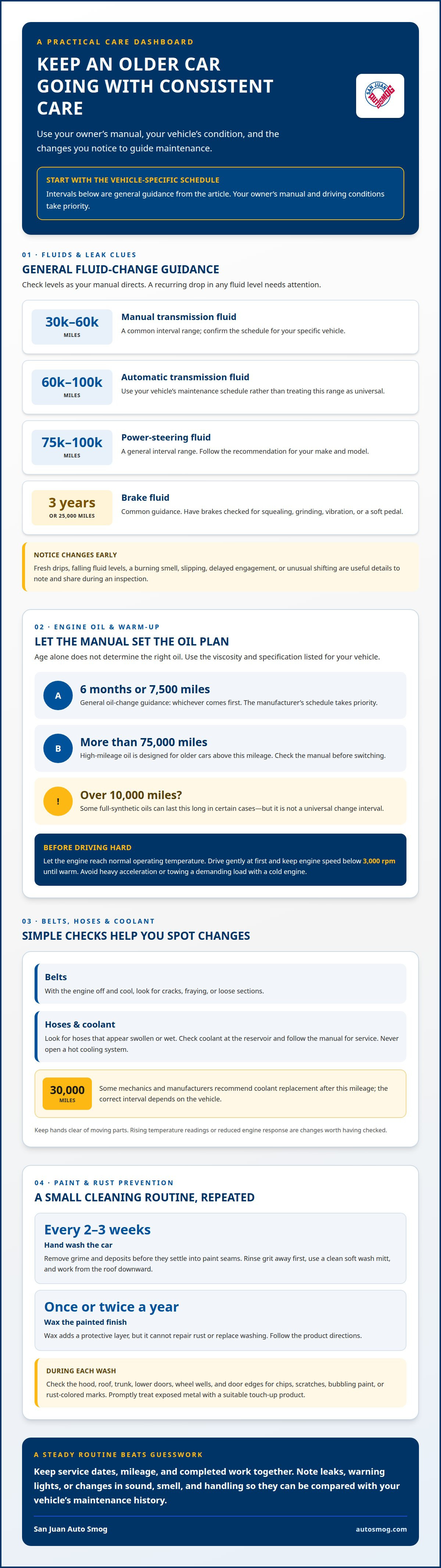
Check fluid levels as the manual directs (an optional fluid check is another way to keep tabs on them), with the car parked safely on level ground. Look beneath the vehicle for fresh drips and note their location and color. Common guidance gives manual-transmission fluid changes at 30,000 to 60,000 miles, automatic-transmission fluid changes at 60,000 to 100,000 miles, and power-steering fluid changes at 75,000 to 100,000 miles. These are general intervals, so follow the schedule for your vehicle. A recurring drop in any fluid level needs attention.
Dark, wet patches, falling fluid levels, or a new burning smell can signal a developing problem. Red or brown fluid underneath may point to a transmission leak. Slipping, delayed engagement, or unusual shifting also warrants inspection. For brakes, notice squealing, grinding, vibration, or a soft pedal. Brake pads and rotors wear according to driving conditions, so have them checked instead of assuming a fixed replacement mileage. Common brake-fluid guidance gives 3 years or 25,000 miles.
Make a note of changes you observe, including where a leak appears and whether a warning light comes on. Share those details during an optional multi-point inspection, which can help identify fluid leaks and developing wear. Specific observations make it easier to focus the inspection and compare findings with your maintenance records. Follow-up checks can show whether a fluid level remains stable or continues to fall.
Follow the schedule in your owner’s manual, which is specific to your car’s make, model, engine, and driving conditions. Use it to time fluid checks and changes, since intervals vary by vehicle.
2. What Type of Oil Does an Older Car Engine Need?
Use the oil viscosity and specification listed in your owner’s manual; age alone doesn’t determine the right oil. High-mileage oil is designed for older cars with more than 75,000 miles, but check the manual before switching. Some full-synthetic oils can last over 10,000 miles in certain cases, yet that isn’t a universal change interval. Follow your vehicle’s schedule and driving-condition guidance.
For many vehicles, general guidance recommends an oil change every 6 months or 7,500 miles, whichever comes first. The manufacturer’s schedule takes priority. A correctly performed full-synthetic oil change uses the required oil grade and filter, rather than choosing a product simply because the engine has high mileage. Keep service records with dates and odometer readings.
Before driving hard, let the engine reach its normal operating temperature. You don’t need to idle most modern cars for 10 minutes; drive gently at first and keep engine speed below 3,000 rpm until warm. Avoid heavy acceleration or towing a demanding load with a cold engine. An older, smaller engine, such as a 1.6-liter four-cylinder, may not suit hauling a trunk full of cinderblocks.
With the engine off and cool, look for cracked or frayed belts, loose sections, and hoses that appear swollen or wet. Belts drive engine accessories, while hoses carry coolant; damage can interrupt operation or allow coolant to escape. Don’t reach near moving parts or open a hot cooling system. Check the coolant level at its reservoir and follow the vehicle’s manual for service. Some mechanics and manufacturers recommend coolant replacement after 30,000 miles, but the correct interval depends on the vehicle.
Citrus Heights summer heat can put extra demands on the cooling system, while dust can clog the engine air filter and restrict airflow. Watch for rising temperature readings or reduced engine response, and have the cooling system or filter inspected if you notice a change. Regular oil and coolant care (the FuelEconomy.gov maintenance tips show how upkeep affects fuel costs), gentle warm-up habits, and visual checks of belts and hoses make a practical routine for older engines.
3. Regular hand washing and waxing to prevent rust
Wash your car by hand every 2 to 3 weeks to remove grime before it settles into paint seams. In Citrus Heights, check the hood, roof, trunk, and lower doors for bird droppings, tree sap, and dirt. These deposits can damage the finish if left in place. Rinse loose grit away first, then use a clean, soft wash mitt so particles are less likely to scratch the paint. Work from the roof downward, and rinse the mitt often.
Pay close attention to places where water and dirt collect, such as wheel wells, door edges, and the underside of the car. Clean these areas gently, then dry the vehicle with a clean towel to limit lingering moisture. Avoid washing in direct sun or when the paint is hot, as this can leave water spots or streaks. If a mark remains, don’t scrape it with a hard tool; use a paint-safe cleaning method instead.
Wax adds a protective layer over paint, but it can’t repair rust or replace proper washing. Waxing once or twice a year can help protect the finish from everyday exposure. Follow the product’s instructions, and keep wax off unpainted trim if its label advises against applying it there. A clean, waxed surface also makes new scratches, chips, and stains easier to spot.
During each wash, check for paint chips and scratches, especially around the hood, wheel arches, and door edges. If a chip exposes metal, promptly treat the spot with a suitable touch-up product to help limit moisture reaching the metal. Look for bubbling paint or rust-colored marks, which can indicate corrosion beneath the finish. Washing and waxing can’t prevent every cause of rust, but regular cleaning and attention to paint damage can help you catch problems earlier.
4. Tire pressure, rotation, and replacement
Tire pressure affects how the tread meets the road, so use the pressure listed on your vehicle’s door placard, not a generic target. The 35 PSI figure sometimes used as a reference isn’t right for every car. Check pressure when tires are cool, and use a gauge for each tire, including the spare if equipped. Recheck after temperature changes or if one tire repeatedly loses pressure. A recurring drop may point to a puncture, valve issue, or other leak.
Many drivers rotate tires every 6 months or every 6,000 to 8,000 miles, though your owner’s manual sets the right interval. Rotation changes each tire’s position to help distribute wear more evenly. The correct pattern depends on the vehicle’s drivetrain and tire setup, so follow the owner’s manual. If a tire shows much more wear on one edge, rotation alone won’t address the cause. Alignment, inflation, suspension condition, and driving habits can all affect tread wear.
Check the tread across each tire, not just the outside shoulder. The NHTSA tire safety guide explains how to read tire age and tread. Built-in tread-wear indicators show when the tread has worn to their level; cracks, bulges, or exposed cords also call for prompt attention. A well-maintained set may last about 50,000 miles or 6 years, but condition matters more than an estimate. Consider replacing tires that are 6 years old or older, since aging can reduce braking traction even when tread remains.
Before a Citrus Heights drive, look for uneven wear, embedded objects, or visible sidewall damage. Don’t remove an object that has punctured a tire, since it may be limiting air loss. Note pressure changes and have recurring loss inspected. An optional multi-point inspection can include a tire-condition check alongside other routine items. Schedule a tire and vehicle inspection to review wear and pressure concerns.
San Juan Auto Smog
San Juan Auto Smog helps you keep routine maintenance and emissions testing organized while caring for an older or high-mileage vehicle. Schedule a full-synthetic oil change when your vehicle’s maintenance schedule calls for fresh oil. San Juan Auto Smog offers full-synthetic oil changes, with a multi-point inspection, fluid check, and tire rotation available as options. If your California smog check is due, a STAR-certified smog check for Citrus Heights drivers addresses that separate testing requirement. An oil change alone does not ensure a vehicle will pass.
San Juan Auto Smog also provides Older Vehicle Smog Checks for models from 1999 and earlier, plus smog checks for RVs, vans, and heavy trucks. As a STAR-certified Test & Repair station (license RC303707), the shop can also diagnose and repair a vehicle that fails. Pairing routine maintenance with a smog visit can make it easier to keep both on your calendar. Proper maintenance supports engine performance and reliability over time.
For help arranging the service that fits your vehicle, contact San Juan Auto Smog at 4701 San Juan Ave in Fair Oaks. Smog checks on 2000 and newer vehicles don’t need an appointment, but please book ahead for oil changes and for smog checks on 1999 and older vehicles, RVs, vans, and heavy trucks. Text (916) 961-6009 to make an appointment.
Build a maintenance routine that fits your next mile
Long-term care works best as part of your regular driving routine, rather than as a reaction to a new noise or warning light. Use your vehicle’s maintenance schedule and service records to plan ahead, and address changes in how the car starts, stops, or handles. This steady approach makes it easier to decide what needs attention next.
If you’re thinking about how to make your car last longer in Citrus Heights, choose a practical next step based on your vehicle’s needs. San Juan Auto Smog offers Full-Synthetic Oil Changes, STAR-Certified Smog Checks, and Older Vehicle Smog Checks for vehicles from 1999 and earlier. These services support routine oil maintenance and emissions testing as separate parts of ongoing vehicle care.
Make your next maintenance step straightforward. Text (916) 961-6009 to make an appointment. Contact San Juan Auto Smog today to discuss the service that fits your vehicle. Consistent care can help you feel more prepared for the miles ahead.
Frequently Asked Questions
Can I Make My Old Car Last Longer?
Yes, consistent care can help an older car remain dependable, and some vehicles can reach 200,000 miles and beyond. Start with a maintenance record, then address active leaks, warning lights, and changes in braking or handling. A vehicle’s condition depends on its history and use, so prioritize safety-related concerns and follow the maintenance schedule for its make and model.
What Type of Oil Does an Older Car Engine Need?
Choose oil that meets the viscosity and specification in your vehicle’s owner’s manual. High-mileage oil is designed for older cars with more than 75,000 miles, but that label doesn’t replace the manufacturer’s oil requirements. If your engine uses oil between changes, record how often you add it and mention the pattern during service. Don’t select thicker oil simply to conceal a new symptom.
How often should I change engine oil, filters, and fluids?
Use your vehicle’s maintenance schedule because oil, filter, and fluid intervals vary by model and driving conditions. Severe-use guidance may apply if you often take short trips, drive in dusty conditions, or tow. Keep service records with the date, mileage, and products used. This helps you tell whether a service is overdue or was already completed by a previous owner.
What tire pressure, rotation, and alignment schedule extends tire life?
Set tire pressure to the recommendation on the vehicle placard, then follow the owner’s manual for rotation timing and pattern. Consider an alignment check if the car pulls to one side, the steering wheel sits off-center, or the tread wears unevenly. Alignment adjusts wheel angles; rotation changes tire positions. They address different issues, so one service doesn’t replace the other.
How can careful driving habits reduce wear on a car?
Accelerate smoothly and brake gradually to reduce abrupt loads on the engine, brakes, and tires. Avoid speeding over potholes or rough pavement, as sharp impacts can damage wheels and suspension components. Remove cargo you don’t need, and don’t carry loads beyond the vehicle’s stated limits. These habits won’t prevent every repair, but they can reduce avoidable strain during everyday trips.
More articles
- How to Find an Honest Smog Shop Near Gold River
- San Juan Auto Smog vs Joessmogcheck: A Fair Comparison
- Quick and Reliable Oil Change in Sacramento With Oil Type Advice
- Fair Oaks auto maintenance for busy parents: Find a trusted garage
- Smog Inspection Cost: What Fair Oaks Drivers Actually Pay
- Why the DMV Sent You to a STAR Station for a Smog Check